





.png)
Mason Johnson
August 12, 2026
How to Create Pillar Pages for AI Search Visibility
Building pillar pages for AI search visibility requires question-driven structure, modular formatting, and demonstrated expertise that AI engines can extract and cite.

Key Takeaways:
- Pillar pages anchor topic clusters by connecting a broad subject to focused cluster pages through internal links, signaling topical authority to AI engines.
- AI engines favor headings written as natural-language questions, with a 40-to-60-word direct answer placed immediately beneath each heading.
- Modular content, like short paragraphs, structured lists, self-contained sections, and declarative sentences, gives AI engines discrete, citable knowledge blocks to pull from.
- Semantic HTML, JSON-LD structured data, and dedicated FAQ sections remove ambiguity and help AI engines parse your content's meaning and structure.
- Jasper's GEO Hub and GEO Agent let marketing teams identify high-citation subtopics, draft pillar pages, and run quarterly freshness audits in one repeatable workflow.
Bottom line: Pillar pages built with question-based headings, modular sections, E-E-A-T signals, and clean semantic structure are the most reliable way to earn AI engine citations at scale.
The AI era of search has upended traditional pathways to online brand visibility, placing a greater emphasis on establishing authority around topics your organization knows best. Google's recent guidance on AEO reinforces this shift, emphasizing that genuine and original expertise is essential for increasing visibility across AI-powered search experiences.
Pillar pages help transform that expertise into a structure AI engines can understand. By organizing a broad topic and its related subtopics into a connected content hub, they establish topical authority, clarify the relationships between concepts, and make it easier for AI systems to retrieve and cite your content when generating answers.
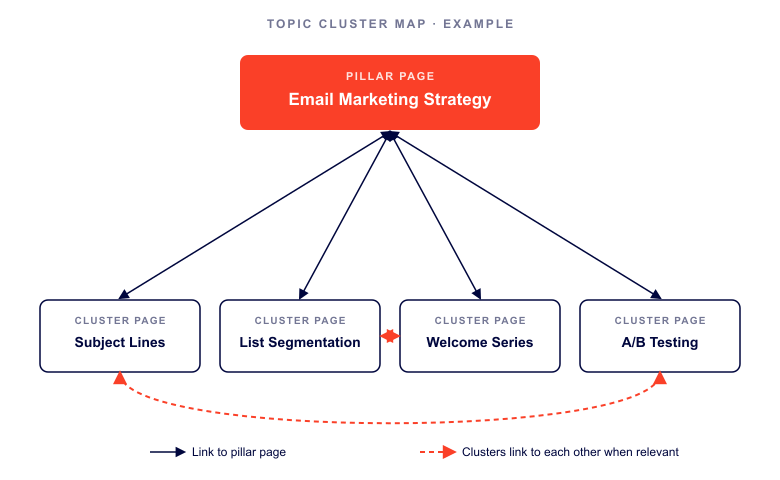
In this example, the "Email Marketing Strategy" page is the pillar: a broad, comprehensive page covering the full topic. It links out to focused cluster pages, like Subject Lines, List Segmentation, Welcome Series, and A/B Testing, each going deep on one specific piece of the strategy.
Every cluster page links back to the pillar, and the pillar links to each cluster, so AI engines and readers can always trace a subtopic back to the broader context. Cluster pages also link directly to each other when the topics genuinely overlap, like List Segmentation and Welcome Series, or Subject Lines and A/B Testing, reinforcing topical authority beyond just the hub-and-spoke connection to the pillar.
This guide walks through the principles, structure, and optimization techniques behind pillar pages that earn trust from both AI systems and the people using them.
What makes a good pillar page for AI search?
A good pillar page does two jobs at once. For readers, it delivers a comprehensive, well-organized answer to a broad topic. For AI engines, it acts as a signal of topical authority, a single page that maps how a subject and its subtopics connect.
The pages that consistently earn AI citations share a few traits:
- Question-driven structure. Organized around how people actually ask, not around keywords.
- Modular sections. Broken into self-contained chunks that make sense even pulled out of context.
- Demonstrated authority. Backed by named authors, original data, and clear sourcing.
- Consistent freshness. Kept current, so retrieval systems don't pass you over for a fresher competitor.
None of these replace good SEO fundamentals like keyword research, link building, and page performance—they build directly on top of them. AI search engines still rely on the same crawlable, indexable content that search has always required, they just apply an additional layer of scrutiny: Can this page be broken into a clear, citable answer, and does it show real expertise behind it?
Pillar pages built with that extra layer in mind are best able to win visibility in AI-powered search environments.
6 Steps to Build Pillar Pages for AI Search Visibility
Pillar pages built for AEO and GEO success need deliberate structure, from how you cluster your topics to how you format individual sections, so both AI engines and human readers can navigate your expertise with clarity and ease.
These six steps are key to building pillar pages that meet both requirements.
1. Build topic clusters around a central pillar page
A pillar page anchors a topic cluster. The pillar owns the broad subject. Cluster pages go deep on specific subtopics. Internal links tie them together, giving AI engines a clear map of how your expertise connects.
Structure your cluster
- Pillar page: the comprehensive hub (for example, "Answer Engine Optimization")
- Cluster pages: focused pieces that expand on each subtopic (for example, "AEO metrics" or "schema markup for AEO")
- Internal links: connect every cluster page to the pillar and to related clusters
Generative engines reward comprehensive knowledge. They synthesize answers from sources that show clear relationships between ideas, so breadth, depth, and organization all carry weight. A well-built topic cluster tells AI exactly how your expertise fits together.
Pro tip: Map your cluster before you write a single page. Ask the GEO Hub for AI search insights on your core topic to see which subtopics and questions are already earning citations, then use GEO Agent to draft your pillar and supporting cluster pages from that research in one workflow.
2. Structure content with question-based headings and summary answers
AI users search in full, natural-language questions. The average answer engine query runs about 23 words, versus three to four words for a traditional keyword search. Your headings should mirror how people actually ask.
The heading-and-answer pattern
Lead each H2 or H3 with a question, then answer it immediately in a tight 40 to 60 word summary. Expand with context, examples, and data below it.
Here's the pattern in practice:
What is answer engine optimization?
Answer engine optimization is the practice of structuring content so AI engines can extract and cite it in generated responses. It focuses on clear answers, modular formatting, and demonstrated expertise.
That opening block stands alone as a complete, correct answer. That's exactly what an AI engine wants to pull.
Pro tip: Build your FAQ and heading structure in Grid, where you can generate multiple question-and-answer pairs side by side and compare which summary answers land tightest before you commit them to the page.
3. Modularize content into extractable chunks
AI engines parse content into small, self-contained pieces to find what matches a query. A section that only makes sense in context is easy to skip.
To make your content extractable:
- Keep paragraphs to three or four sentences, each carrying one complete thought
- Write self-contained sections that hold up when pulled out on their own
- Use bullet points and numbered lists for steps, criteria, and comparisons
- Add a short summary at the top of long sections
- Write quotable sentences: plain, declarative statements that restate your key point
Treat each section as a knowledge block. An engine can cite one precise block even if it never surfaces the full page. The more independently each section can stand, the more chances your content has to appear in generated answers.
Pro tip: Add your extractability rules (short paragraphs, one idea per section, quotable declarative sentences) as a rule in your Style Guide within Jasper IQ. Once it's codified there, every future draft follows the modular pattern automatically.
4. Use semantic HTML and FAQ sections
Machine-readable structure removes ambiguity about what your content means and how its parts relate.
Technical building blocks
- Use heading tags hierarchically (H1, H2, H3) and never skip levels
- Add JSON-LD structured data and validate it with Google's Rich Results Test
- Mark up tables, quotes, and definitions with the right HTML tags
- Include a table of contents with anchor links on long pillar pages
Add a dedicated FAQ section
FAQs mirror conversational queries and match the exact format AI engines prefer to extract. Base yours on real user questions and "People Also Ask" results. Follow a definition, process, then example flow, and keep each answer to two or three sentences before adding supporting detail.
Takeaway: Clean semantic structure and FAQs give AI engines the machine-readable clarity they need to cite you.
5. Demonstrate E-E-A-T with authors and first-party data
As AI makes content easy to generate at scale, original expertise becomes your sharpest differentiator. Your organization's experience, proprietary research, customer insights, and expert perspective are assets no generic content can replicate. Those signals build E-E-A-T and establish your content as a trustworthy source.
Strengthen expertise, authoritativeness, and trust with:
- Named authors and detailed bios with real credentials
- Proprietary data, studies, and benchmarks you own
- Original screenshots, case studies, and examples from lived experience
- Clear attribution that separates facts, opinions, and recommendations
- Links to primary, authoritative sources for every claim
First-party data carries special weight. A proprietary statistic, benchmark, or customer insight gives AI systems original evidence tied directly to your brand, which makes it more valuable to cite.
Pro tip: Pull from your Knowledge Base to surface proprietary data, past case studies, and internal research you already have on file. It's often the fastest path to first-party proof points you'd otherwise spend hours digging up.
6. Keep content fresh with timestamps and change logs
AI retrieval layers favor content that looks current, especially in fast-moving categories. A simple freshness routine keeps your pillar pages earning citations over time.
Maintain freshness with:
- Quarterly accuracy audits on your top pillar pages
- Visible "last updated" dates and change logs
- Refreshed statistics, examples, and screenshots with current data
- Fixed broken links and outdated references
- New publish dates on significantly revised pages
Pro tip: Set a quarterly cadence and ask GEO Agent to scan your top pillar pages for outdated stats, broken links, and stale examples to maintain content freshness. It turns a manual audit into a repeatable check.
Put pillar pages to work in Jasper
Pillar pages have become more than an SEO best practice. In an AI-mediated world of online search, they help transform your expertise into a connected knowledge hub that AI engines can understand, retrieve, and confidently cite.
The organizations that win the most AI visibility won't necessarily publish the most content but will build the clearest and most authoritative resources around the topics they know best, then continue strengthening those resources as their expertise evolves.
With Jasper, marketing teams can turn that strategy into a repeatable, scalable workflow. GEO Hub uncovers the topics and questions that matter most in AI search, while GEO Agent helps you create and optimize pillar pages that can strengthen topical authority and position your brand to become the source AI engines choose to cite most.
Ready to be in-the-know about your brand’s AI search visibility? Learn more about how the GEO Hub and GEO Agent give you always-on GEO.
v

More of the latest & greatest

Crawl, Walk, Run: How to Sequence Your AI Search Program
A practical framework for building AI search maturity in the right order, from accurate visibility to measurable business impact.
September 23, 2026
|
Kurt Lambert

From GEO Insight to Action: 5 Takeaways from Jasper + BCG X
How marketers can turn AI search intelligence into a continuous system for improving brand visibility.
September 11, 2026
|
Tom Newton

How To Use the Jasper × Jira Integration: Keep the Work on the Ticket That Tracks It
The Jasper Jira integration sends finished content from Jasper into a Jira issue, so the deliverable sits on the ticket your team is already tracking it with. This guide covers what it does, why it matters, and how to turn it on.
September 10, 2026
|
Jessica Kennedy