






.png)
Megan Dubin
April 16, 2026
Digital Marketing’s New Operating Model
Featured leaders from Forrester, Samsara, and Blue Yonder share how AI is changing websites, channel strategy, brand building, and marketing operations.

The ways buyers discover and evaluate brands have changed, ushering in a new operating model for digital marketing.
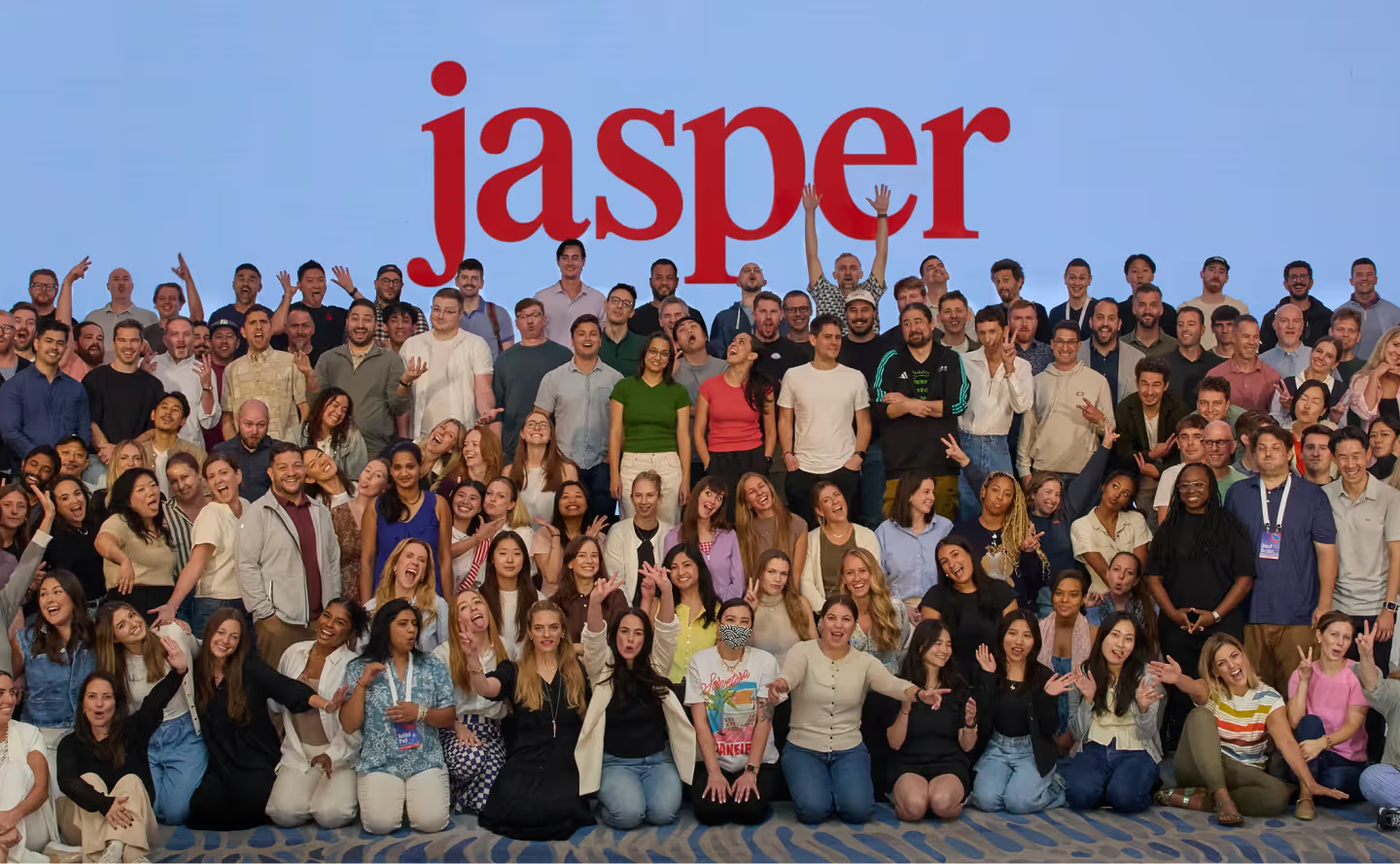
At Jasper’s Executive Summit, guest speakers Lisa Gately, Principal Analyst at Forrester, Jen Whalen, Head of Digital Strategy at Samsara, and Mary Dantzler, VP, Digital and Events Marketing at Blue Yonder, discussed what that shift looks like in practice.
Their conversation pointed to a bigger truth: digital marketing is no longer centered on a website, a search ranking, or a single team. It’s becoming a broader discipline shaped by AI-driven discovery, cross-channel visibility, and tighter coordination across marketing.
Here are four shifts standing out now.
1. The website is moving downstream
For years, the website was built for discovery. Now it plays a stronger role in decision-making.
Buyers are doing more research before they ever land on your site, often through AI tools and answer engines. Research by Forrester finds that 95% of B2B buyers are using AI tools to gather information and compare vendors. By the time they arrive, they are more informed and closer to action.
“We are seeing a significant decrease in organic traffic to our digital properties, but it’s more qualified traffic,” Mary said. “It’s actually buyers that are more ready because they’ve done all the research already.”
That changes the role of the site. It calls for tighter navigation, clearer pathways, and more utility.
At Blue Yonder, Mary described “a tale of two websites,” one built to perform in answer engines and another built to deliver a strong human experience. Jen raised a similar idea at Samsara, asking whether brands may need one layer of content designed for agents and LLMs and another for buyers ready to convert.
2. Channel mix is expanding
If discovery is happening everywhere, channel strategy has to follow.
This requires rethinking where buyers gather information and adjusting faster than traditional channel plans allow. It’s also blurring the lines between paid, organic, and off-site influence.
At Blue Yonder, that has meant shifting paid investment toward more mid- and bottom-funnel intent while also testing new formats. “We’re shifting a larger portion of our paid dollars into YouTube placements,” Mary said, because video is becoming “a rising star in terms of content engagement.”
Jen shared a similar view from Samsara. “We’re trying Instagram. We’re trying TikTok. We’re diversifying and trying all of these platforms because people are getting their information from everywhere right now.”
3. Brand and digital are converging
Answer engines pull from far more than your website. They incorporate press coverage, reviews, social conversations, forums, and third-party sources. Inconsistent messaging does not stay isolated. It gets surfaced and amplified.
“We have had to strengthen our relationship with our PR team to make sure that everything that they are saying is what we are saying so that our citations are accurate,” Jen said.
Lisa reinforced that visibility alone is not enough. “You’re connecting this to accuracy, relevance, and brand sentiment,” she said, highlighting how AI systems interpret and synthesize brand signals. Mary added that Blue Yonder is now looking at citations and mentions alongside sentiment as core indicators of performance.
4. AI transformation needs coordination across teams
AI adoption is accelerating inside marketing teams. The challenge is coordinating how those agents are used.
At Samsara, the company tracks internally-built agents in a central system. At the time of the panel, there were 77 agents in various stages of development in marketing alone. The company is also considering what new roles may be required to support and maintain these agents.
That highlights a broader need. As AI use expands, governance becomes critical. Teams need visibility into what’s being built, how it’s being used, and how it aligns with broader goals.
Lisa emphasized that this work requires shared ownership. “This is not just a one team kind of game.” Success depends on how well teams align across digital, brand, content, PR, and operations. Clear coordination will matter more than the number of tools or agents in use.
For additional insights, read Lisa’s recent Forrester blog here.
Building in motion
There is no fixed playbook for this shift. Teams are learning in real time, adjusting as buyer behavior evolves.
As Mary put it, success increasingly comes down to keeping pace: “It’s making sure that our content stays fresh, relevant, and valid across all of the different destinations and endpoints that we are trying to reach.”
When influence extends across every surface where buyers and agents search for answers, the advantage comes from how well teams can respond to the moment and scale what’s working.
Curious how marketing leaders are developing their teams for this new reality? Explore the guide: Reinventing Marketing Teams for the Operational Era of AI.

More of the latest & greatest
.png)
New in Jasper GEO Hub: Connect the Questions Buyers Ask to the Content You Improve
Jasper GEO Hub now runs each prompt five times per AI provider, discovers pages automatically, and maps prompts to pages so teams know what to optimize.
October 13, 2026
|
Mason Johnson

What the 2026 State of AI in Marketing Data Means for Financial Services
Jasper's latest research reveals what financial services marketers need to scale AI execution while maintaining the governance and oversight their industry demands.
October 9, 2026
|
Jessica Kennedy

Optimizing Product Content for AI Search Engine Recommendations
Discover how to build product content that AI shopping engines can accurately understand and consistently recommend.
October 8, 2026
|
Mason Johnson