





Jessica Kennedy
July 28, 2026
How to Use Jasper’s GEO and Brand Compliance Diagnostic Tools
Jasper's free diagnostic tools give enterprise marketers the visibility they need to continuously govern and improve AI search visibility.

Last Updated: October 8, 2026
Every day, AI search engines answer questions about your category, name the brands worth considering, and shape how buyers see the competitive landscape before a single sales conversation happens. Brands getting cited in this environment are those whose content AI can easily find, extract, and trust.
Yet most enterprise teams still have little to no visibility into how their brands perform in AI search environments. While 94% of B2B buyers report using AI in their decisions, just 22% of brands have integrated AI search into their overall search visibility strategies, with many saying they manually check LLMs to understand how they appear.
This kind of effort is simply not feasible at enterprise scale. Without a systems-level way to monitor what AI says about your brand, how it affects your overall sentiment and visibility, and whether your governance strategy is keeping your brand message on track, it’s impossible to maintain a consistent, trustworthy online presence.
Jasper built two free diagnostic tools to help marketing teams close that gap: the GEO Diagnostic reveals what AI is saying about your brand right now, while the Brand Compliance Diagnostic shows how consistently your content supports accurate brand representation.
Run either diagnostic—or both—and you'll get a clear, immediate benchmark to start optimizing your content and your website for AI search visibility while building stronger connections with your target audiences.
Key Takeaways
- Jasper's free diagnostic tools provide baseline scores for AI search visibility and brand compliance.
- The GEO Diagnostic measures brand presence, citation rates, and sentiment in AI-generated answers.
- The Brand Compliance Diagnostic identifies inconsistent messaging and brand governance issues.
- Both tools provide actionable recommendations to help teams prioritize content improvements.
- Repeating the diagnostics after meaningful updates helps teams measure progress over time.
What is the Jasper GEO Diagnostic?
The GEO Diagnostic answers a question most enterprise teams can’t currently answer: What is AI actually saying about your brand?
Generative engine optimization (GEO) is the practice of improving how your brand appears in AI-generated answers across platforms like ChatGPT, Claude, and Gemini. Unlike traditional search, where established tools make rankings relatively easy to track, AI visibility is largely invisible by default. The GEO Diagnostic makes it measurable.
Running the Jasper GEO Diagnostic provides a breakdown across three dimensions:
- Brand Presence: See how often you appear across different AI models, identify queries where competitors appear and your brand doesn’t, and find specific opportunities to strengthen your presence.
- Citation Rate: Learn how often AI links directly to your website as the source when it mentions your brand. This helps uncover situations where AI knows your brand but directs buyers to review sites, publishers, or competitors for more information.
- Brand Sentiment: See how AI describes your brand, including the language and attributes it associates with you. You can identify inaccurate, unclear, or incomplete representations before they become more firmly established.
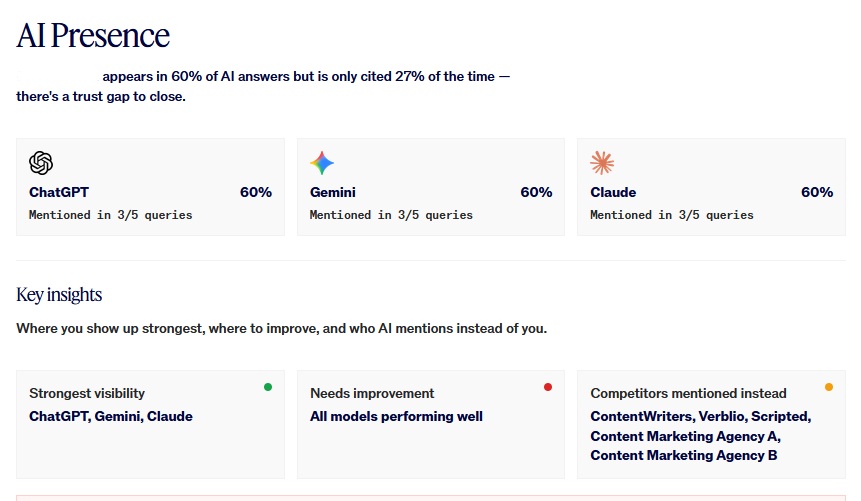
You’ll also receive an Overall Score that combines all three dimensions into a single benchmark of your current GEO standing. Each finding includes supporting evidence, severity, and a recommended fix, giving your team a clear starting point for improving how AI represents and cites your brand.
What Is the Jasper Brand Compliance Diagnostic?
Getting cited by AI only matters if AI describes you accurately. That’s where the Brand Compliance Diagnostic comes in.
AI models synthesize descriptions of your brand from the content available to them. When your messaging varies across pages and digital surfaces, those inconsistencies can contribute to a diluted or distorted representation of your brand.
The Brand Compliance Diagnostic scans your website and public-facing content to evaluate how consistently your brand governance standards are reflected across what you publish. It delivers:
- A Brand Integrity Score. A measurable assessment of how consistently your published content aligns with a unified brand voice, style, and messaging framework.
- Specific compliance findings. See where tone, style, messaging, or voice varies across your live pages, including examples of content that has drifted out of alignment.
- Recommended fixes. Get actionable guidance for bringing inconsistent content back on-brand and strengthening governance across your site.

Together, the GEO Score and Brand Compliance Score provide a dual-lens view of your brand: how AI currently represents it and how consistently your own content communicates the brand you want it to see.
How to Apply Your Diagnostic Results
Running the diagnostics takes minutes, but the real strategic work begins when you turn your findings into a focused plan for improving AI visibility and brand consistency. These are the most important next steps for turning your diagnostic insights into action.
Prioritize the findings that matter most
Start by sorting your findings according to business relevance and severity. Focus first on buyer queries tied to priority categories, products, use cases, and comparisons, especially where your brand is absent, a competitor is cited instead, or your positioning is represented inaccurately.
For each priority finding, identify the affected query or page, the goal it supports, and the team responsible for handling it. This turns your report into a manageable backlog tied to the topics that influence awareness, consideration, and revenue.
Turn GEO findings into a content plan
Use the GEO Diagnostic findings to decide whether you need to originate new content, optimize an existing page, or strengthen your position against a competitor.
If your brand is missing from an important query, determine whether you have a page that answers it directly. If AI mentions your brand without citing your website, review the sources it does cite for differences in evidence, depth, structure, and clarity. If your Brand Sentiment findings reveal inaccurate positioning, strengthen the pages that define your company, products, and category.
From there, you can translate each priority gap into a concrete action, for example: create a missing comparison, add evidence to a key claim, clarify an answer, expand coverage of an important topic, or update a page that no longer reflects your positioning.
Address brand inconsistencies at the source
Review pages flagged by the Brand Compliance Diagnostic and group the findings into recurring issues across voice, tone, style, and messaging. A pattern of conflicting product descriptions, inconsistent category language, or outdated positioning usually points to a broader governance gap.
Resolve that gap in the internal standards guiding your content first. Confirm the approved language for core positioning, product descriptions, differentiators, terminology, and voice, update any affected pages, and share updated standards with the teams creating future content.
Establish a baseline and measure progress
Record your initial GEO and Brand Compliance scores alongside the date, priority findings, and actions you plan to take. This creates a baseline that you can use to evaluate whether content and governance improvements are moving your brand in the right direction.
Run the diagnostics again after making meaningful updates (wait at least 30 days) and compare the new findings with your starting point. Look beyond the overall scores to see whether priority queries gained presence or citations, inaccurate descriptions improved, and previously flagged pages moved back into alignment.
Repeat the process periodically to identify new gaps as your content, competitors, and AI answers evolve.
Build a Long-Term System for AI Search Visibility
The insights from Jasper’s diagnostic tools provide an immediate baseline for action and improvement. Sustained optimization requires an ongoing system that can keep pace as AI answers evolve, new opportunities emerge, and competitors gain ground.
Jasper’s GEO Hub and GEO Agent provide end-to-end, always-on support for that work. GEO Hub monitors how your brand appears across AI search surfaces, while GEO Agent turns those insights into targeted, data-backed action. Together, they help teams create new content, optimize existing pages, and respond quickly to changes in the competitive landscape.
By connecting visibility insights directly to execution and measurement, Jasper makes AI search optimization a continuous, brand-governed process.
Start with your free GEO and Brand Compliance scores, then explore Jasper’s GEO Hub and GEO Agent to build a durable system for shaping how AI discovers, cites, and represents your brand.
Frequently Asked Questions
What are Jasper's GEO and Brand Compliance Diagnostic tools?
Jasper's GEO and Brand Compliance Diagnostic tools are free assessments that help marketers evaluate AI search visibility and brand consistency. The GEO Diagnostic measures how AI engines represent and cite a brand, while the Brand Compliance Diagnostic analyzes published content for inconsistencies in brand voice, messaging, and style.
How does Jasper's GEO Diagnostic work?
Jasper's GEO Diagnostic evaluates a brand's presence, citation rate, and sentiment across AI-generated answers. It identifies queries where competitors appear instead of the brand, examines whether AI cites the brand's website, and assesses how AI describes the brand. The tool provides an overall GEO Score and recommended improvements.
Which AI models does Jasper's GEO Diagnostic evaluate?
Jasper's GEO Diagnostic evaluates brand visibility across ChatGPT, Claude, and Gemini. It provides model-specific insights into brand presence, citation rates, and sentiment, helping marketers understand how their brand appears in AI-generated answers and where visibility gaps exist.
What does Jasper's Brand Compliance Diagnostic measure?
Jasper's Brand Compliance Diagnostic measures how consistently a website's public content follows brand standards. It evaluates brand voice, tone, style,

.png)
More of the latest & greatest

Governance First: How Financial Services Marketing Teams Scale AI Without Slowing Down Review
Financial services marketers can’t scale personalization, speed, or AI search visibility on review alone. Brand governance has to come first.
October 22, 2026
|
Jessica Kennedy

When AI Gets Your Brand Wrong: The Accuracy Problem Nobody Is Tracking
How to identify inaccuracies in AI-generated answers and improve how AI search engines represent your brand.
October 22, 2026
|
Kurt Lambert

Monitor, Decide, Act, Measure: Where Humans Stay in the Loop on AI Search
A practical framework for using AI agents to manage GEO workflows while keeping marketers in control of key decisions.
October 21, 2026
|
Kurt Lambert