


.png)
Timothy Young
June 16, 2026
Introducing Jasper GEO Agent and GEO Hub: End-to-End AI Search Optimization
Jasper's end-to-end system for turning AI search visibility into consistent, compounding brand authority.
Until recently, we lived in phase one of organic search. Traditional SEO became something marketers knew how to measure, manage, and optimize. Google rankings were visible. Traffic was attributable. The playbook was clear.
Then generative AI changed the rules overnight.
Today, AI search is the number one self-guided interaction across every phase of the B2B buyer journey. According to Forrester, 94% of B2B buyers already use it to make purchase decisions. Organic traffic is declining. The shift is not theoretical anymore. It's in the pipeline numbers.
But declining traffic is only part of the problem. AI doesn’t just surface brands differently than Google; it actively characterizes them. It generates brand descriptions, comparisons, and recommendations based on fragmented signals pulled from analyst reports, reviews, third-party sites, social platforms, and your own content.
And often, AI gets it wrong. It misrepresents brands 60% of the time, and when that goes unaddressed, it doesn't stay wrong in one place but hardens into a consensus across all the AI platforms your buyers use.
This is the new competitive battleground. The question is no longer whether your brand appears in AI-generated answers. It's how you're represented. Most teams still run workflows designed for traditional search, and built for a world where they controlled their own message. In the AI search era, that's no longer enough.
Winning in search today means building a new kind of authority and content structure that AI can recognize, trust, and cite accurately. Most marketers know this. The challenge now is gaining the insight to turn that knowledge into action and impact.
We built the GEO Agent and GEO Hub to deliver on both. I’m excited to share how they can help your teams turn AI search from a source of uncertainty to a powerful competitive advantage.
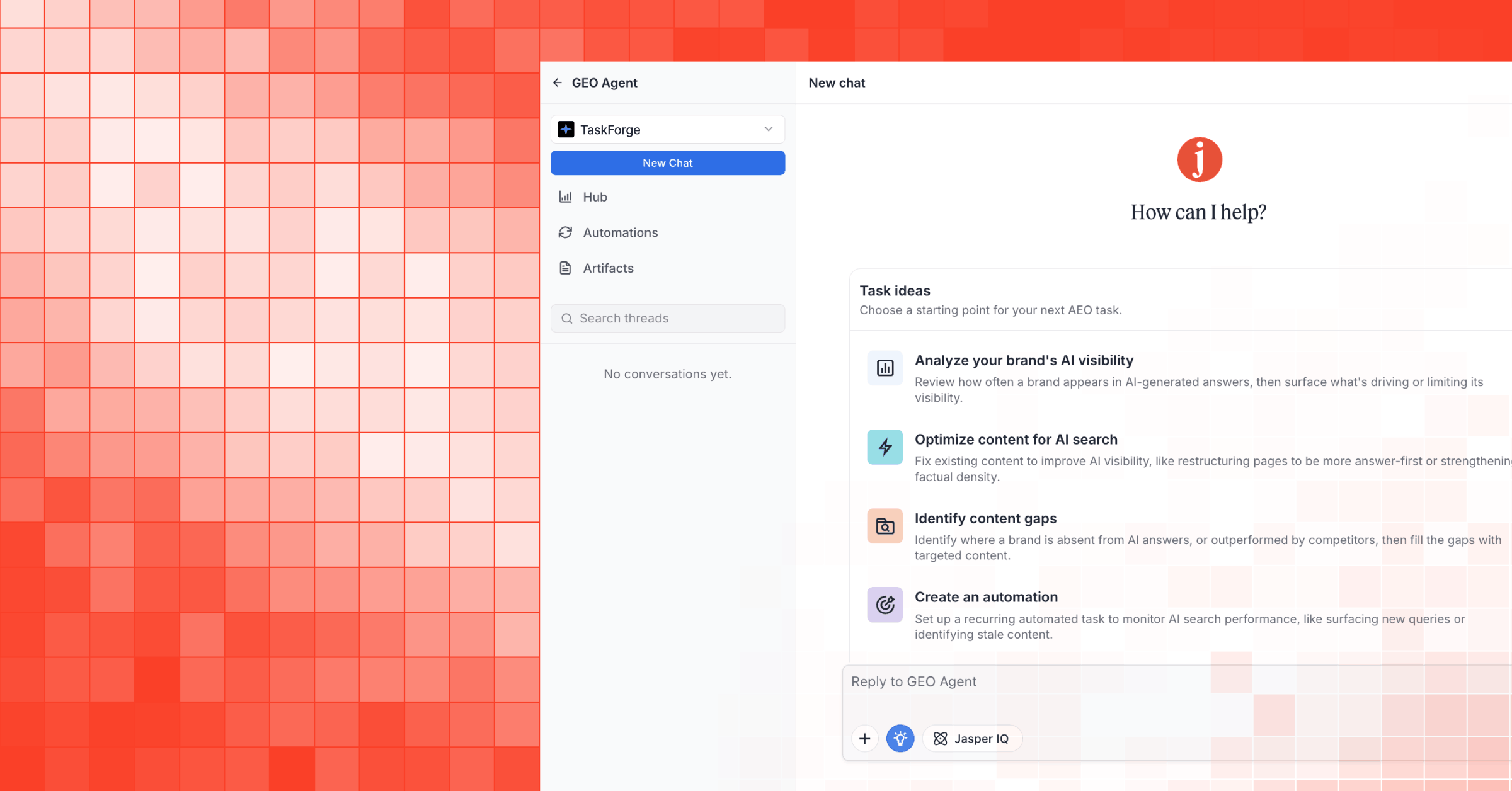
Introducing the Jasper GEO Agent
The GEO Agent is Jasper's autonomous engine for AI search optimization. It continuously analyzes how your brand appears across leading AI platforms like ChatGPT, Gemini, and Claude, and identifies where you’re being misrepresented, underrepresented, or outranked by competitors, and executes the workflows needed to fix it.
As part of Jasper's broader marketing agents platform, the GEO Agent can also coordinate other Jasper agents to run optimization tasks automatically, and at a scale no team could manage on their own.
This is the shift the moment requires—not just understanding how AI platforms represent your brand, but continuously influencing that representation over time.
Not a monitoring dashboard. Not a content tool. An intelligent, autonomous agent that understands the evolving AI discovery landscape and continuously works to improve your position in it.
Introducing the Jasper GEO Hub
The GEO Hub is the intelligence layer that powers the GEO Agent, and the command center where your team directs it. It connects AI search visibility intelligence, prioritized recommendations, and agent-driven execution into one governed platform.
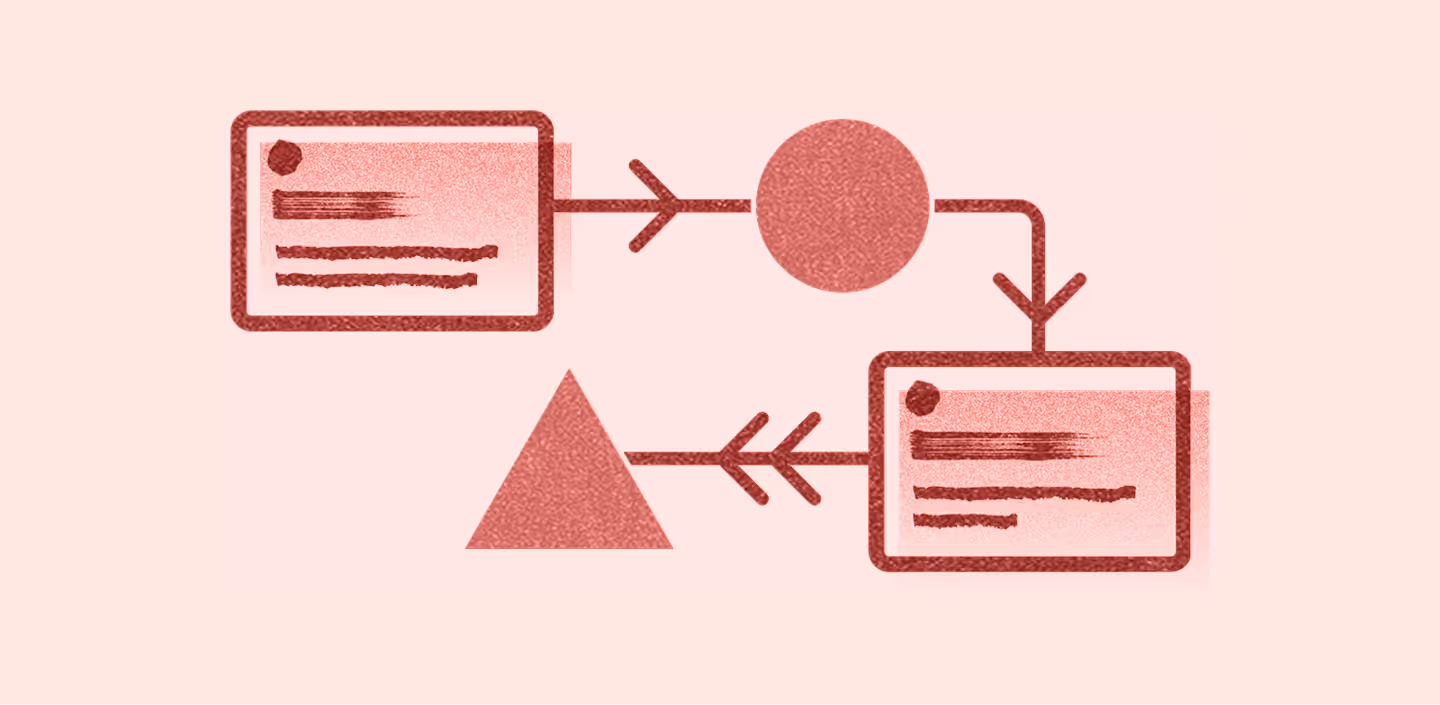
At the heart of the GEO Hub is a four-stage operating model that makes AI visibility a continuous, self-improving loop:
- Monitor: Track your brand's presence, citations, sentiment, and competitive share of voice across AI platforms
- Decide: Decision Intelligence (IQ) synthesizes those signals and ranks opportunities by impact so teams always know where to focus
- Act: The GEO Agent executes directly from IQ's recommendations through three workflows: Originate, Optimize, and Outrank
- Measure: Results feed back into the next monitoring cycle, so every loop starts smarter than the last
Each stage connects directly to the next, giving teams a clear and repeatable path from visibility signal to content that earns true brand authority.
This is what sets the GEO Hub apart. Many tools can track AI visibility. Others generate content. The GEO Hub closes the loop, connecting visibility insight directly to autonomous execution.
From visibility to action
Before the GEO Agent can act, it needs to see clearly. The GEO Hub's monitoring layer tracks your brand across AI platforms continuously, surfacing five scores that give your team and leadership a shared language for where you stand:
- Overall Score: A single headline metric combining brand presence, citation rate, and sentiment
- Brand Presence Score: How often your brand appears when AI is asked about topics you should own
- Citation Rate Score: How often AI systems trust your content enough to cite it as a source
- Brand Sentiment Score: How AI characterizes your brand, an early warning system for misrepresentation
- Share of Voice: Where you stand relative to competitors, by topic and by AI model
These scores are inputs to Decision Intelligence (IQ), which synthesizes every signal with your brand context, competitive intelligence, and content performance history to rank your opportunities by projected impact.
Those priorities connect directly to three agent-driven workflows the GEO Agent executes inside Jasper:
- Originate to create net-new content on high-intent topics where your brand has limited or no AI presence
- Optimize to make existing content AI-ready, improving structure, freshness, and citation signals at scale
- Outrank to identify where competitors are being cited and execute targeted responses to reclaim share of voice
Each executes from IQ's recommendations without tool-switching or manual coordination in between. And because the entire system is powered by Jasper IQ, your brand voice, governance, and performance context are all embedded directly into every workflow. That means you can scale AI discoverability optimization while maintaining the consistency, compliance, and control that enterprise marketing demands.
Authority that compounds
Every time the GEO Agent acts on IQ's recommendations, the next monitoring cycle shows exactly what moved the needle:
- Which scores improved
- Where authority grew
- Where new gaps emerged
That feedback loop separates enables your team to build lasting visibility across AI search channels, and the compounding effect is measurable.
Because every cycle connects actions to outcomes, your team always has a clear answer to the questions that matter most: How are we performing now in AI search, and how is our strategy making an impact?
The GEO Agent and Hub don't just help teams perform better; they give them a way to prove it.
The moment to lead is now
My vision for Jasper has always been to collapse the gap between insight and execution into a single governed system, one where every marketing team always knows where they stand, what to do next, and whether it's working. The ability to do that in real time, at scale has never been more critical.
The GEO Agent and GEO Hub are the most complete expressions of that vision we have shipped to date, and it's just the beginning. Both are available now.
It's still early days for AI search. Teams that establish authority now, systematically, consistently, and intentionally, will define the competitive landscape for years to come. I genuinely believe that, and I can’t wait to see what you build with it.
.png)
More of the latest & greatest

From GEO Insight to Action: 5 Takeaways from Jasper + BCG X
How marketers can turn AI search intelligence into a continuous system for improving brand visibility.
September 11, 2026
|
Tom Newton

How To Use the Jasper × Jira Integration: Keep the Work on the Ticket That Tracks It
The Jasper Jira integration sends finished content from Jasper into a Jira issue, so the deliverable sits on the ticket your team is already tracking it with. This guide covers what it does, why it matters, and how to turn it on.
September 10, 2026
|
Jessica Kennedy
9 AEO/GEO workflows for your new AI search team
Build repeatable AEO/GEO workflows across content, PR and communications, and marketing ops to improve your brand’s visibility in AI search.
September 4, 2026
|
Jasper Marketing