- Log In
- Free Trial
- Get A Demo
GEO & AI Optimization
Win the new front door of search
Measure how your brand performs across every major AI answer engine, prioritize the actions that matter, and ship brand-governed content at scale.







GEO Diagnostic
Learn what AI is saying about your brand, where the gaps are, and what governs the brands AI cites instead.
Brand Compliance Diagnostic
Scan your website and public content to learn how consistently you score for brand governance and compliance.
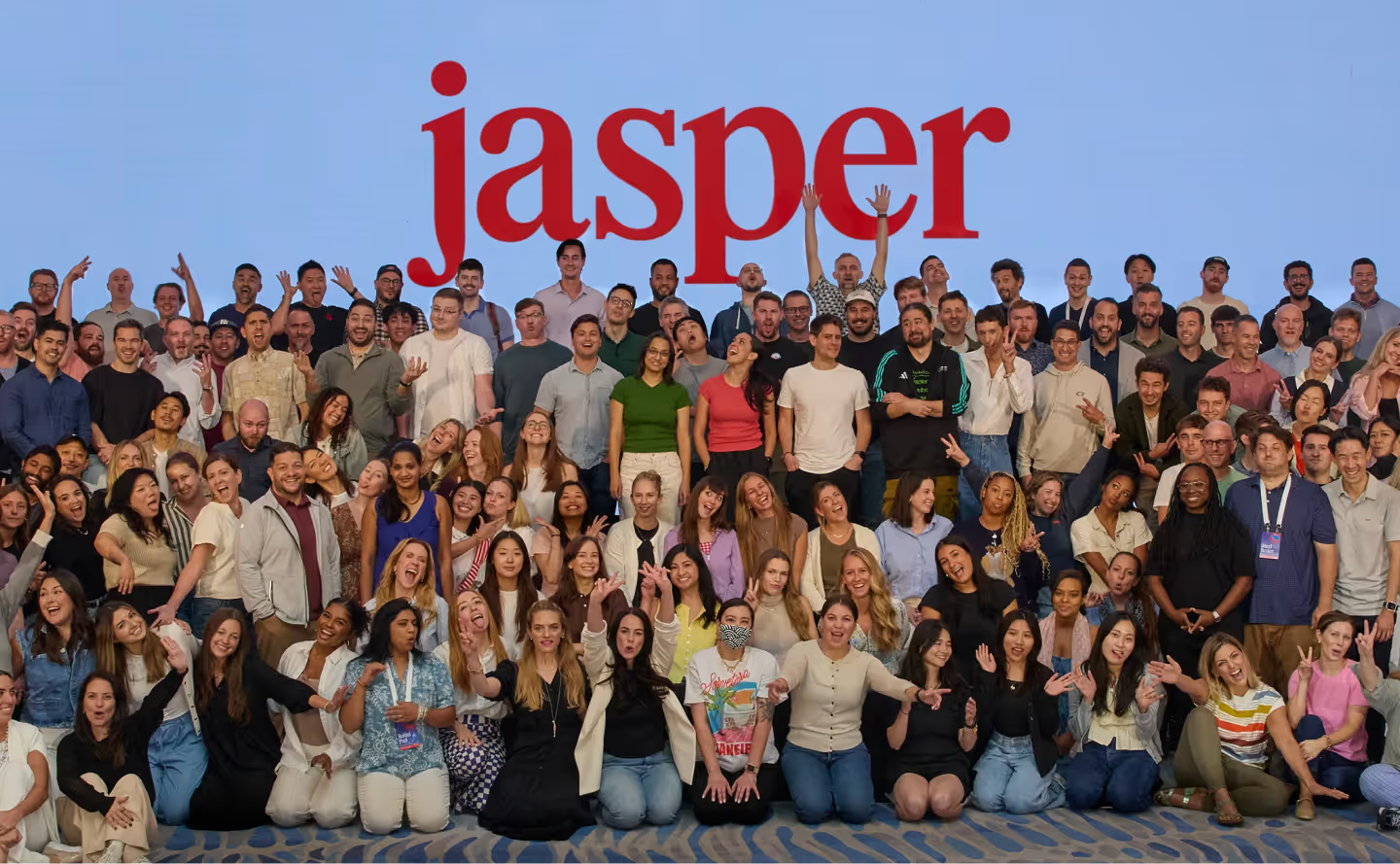
Unlocking People for AI Transformation: Change Management that Sticks

+
%20-%20Flame.svg)
Replay
November 5, 2025 11:00 AM
EST
Unlocking People for AI Transformation: Change Management that Sticks
A conversation from Jasper Assembly
You should be redirected shortly...
The Webinar Replay recording is coming soon.
Fill out this form to get the recording when it's ready.
Missed the webinar?
Fill out this form to watch the replay.
What we covered
AI transformation isn’t just a technology shift — it’s a people shift. In this opening keynote, former Chief People Officer Alex Buder Shapiro will share a pragmatic, human-centered approach to change management that turns uncertainty into momentum. She’ll outline how leaders can unlock adoption by designing trust-first rollouts, building capability ladders that meet employees where they are, and aligning incentives with outcomes.
Then Alex welcomes Raakhi Agrawal, Managing Director & Partner at BCG, for a fireside chat on balancing growth and change in a people-centric way — from setting the right pace and governance to measuring progress without stifling innovation. Attendees will leave with an actionable blueprint for mobilizing teams, de-risking adoption, and scaling the behaviors that make AI ROI durable.
Full Transcript
Welcome and Opening Remarks
Steve Kearns: All right, Good morning everybody. Hopefully folks had a lovely chance to get some rest. It was great spending time with everyone yesterday, I think. You know, I've said this before, but the big takeaway I have from this is that so many folks are facing both similar challenges, but then how we're thinking about addressing those challenges with regard to AI transformation is so unique that, you know, I feel like every time I leave these Jasper events I'm getting more and more insights about ways that you can embrace AI transformation Content systems, scaled content in, in ways that I had never thought possible before. We have an action packed agenda for you today specifically that's going to focus on some of those ways and use cases that people are leveraging Jasper to help scale content systems.
But before we get to that, we're going to talk about the people side of the equation. So something that is very top of mind, I'm sure for everyone in the room, is how we actually get our teams and ourselves engaged in this AI transformation journey. Not every marketer is super excited about this. Some people are scared. Some people are on different ends of the spectrum when it comes to how we adopt this new technology.
So to talk through what that looks like, we have our Chief People Officer Alex Butter Shapiro to walk us through a conversation there. So I will welcome Alex and thanks so much.
The Human Side of AI Transformation
Alex Buder Shapiro: See, I can tell who has an elementary school aged kid by how much you dance to that song. That's the only thing we're doing. It was the Halloween costume of 60% of the elementary school. See? Okay, good, good to get you started on day three of the summit.
So I'm Alex. I'm the Chief People Officer here at Jasper. I came today to share with you a bunch of learnings that I've had building an AI Forward culture at Jasper.
And then I'm going to terrify my comms and marketing team and tell you I rewrote the whole thing this morning because genuinely I learned so much from all of you in listening and learning that the slides are the same. But I want to tell you some of the stories that you all have been telling me over the last few days and some of the anecdotes that have really resonated with me because I think this is actually the group of change agents that needs to go back to your own organizations and think through how to drive that change. And so I want to just share some of the tools and learnings that I have.
But I also want to hold space for you to learn from each other and to keep this conversation going. So When I joined Jasper about two and a half years ago, this was kind of the central thesis. When I came to the organization, it was, you know, we needed to listen and learn from our customers what your pain points were and we needed to build that into tools and features in our own platform so we could really help you drive results.
But as you heard yesterday, what we've really seen is that it is not just the tools, not just that process, but it's also the people that drive that change. And I'm sure everybody here can imagine which one of those is my favorite to talk about. I am slightly biased, but when I first came to Jasper, a lot of people said, what are you doing as an HR leader in an AI company? Isn't that going to change everything you do? Like capital P people leader, lowercase P people leader. Isn't that going to shake things up for you?
And I think the real insight of my time here is just how critical being human centered in your AI implementation is and being human centered in how you build the culture that supports that implementation.
Principles for Building an AI-Forward Culture
Alex Buder Shapiro: So if you're a current customer or been somewhere in our customer journey, maybe sales or CS has shown you this slide. It is our very idealized version, in my opinion, of what it looks like to really transform with Jasper. First you start as individuals, maybe some of you have already moved on to that team stage, but you're really looking to unlock a level of business results, a level of growth at the organizational level that really transforms how you work.
But this is my favorite curve. Just like Brian has his spreadsheets, I have favorite change management curves. And I love this one because it talks much more about the internal psychology of what's going on in people's minds as they go through these big moments of change. I'm actually going to rename the end of it Work Joy, because I thought Madeline's comment yesterday was just such a beautiful way to think about the journey that we're traveling, but it isn't a linear one. And, and actually a lot of times I affectionately call this nadir, the Valley of Despair. That is the precise moment where all of your excitement and confidence, maybe overconfidence, translates to a moment of incompetence.
And it's the moment where all of the skills that you've been building and the work you've been doing to progress your career forward suddenly feels irrelevant. And all of a sudden you have to really re envision how you're going to get your work done. And I think Loreal started off yesterday by talking about these Unprecedented times, these uncertain times. In my line of work, what I see is that people actually crave precedent, they crave certainty. They want the stability that comes with understanding that their actions can lead to the results they care about.
And so the truth is, people actually slide back down this hill and travel this curve many times over when they're learning something new. And this might be the team of change agents, but part of what we're asking of you is to go back and, and go into your organizations and think through how you drive that change. And so, like I said originally, what I wanted to do was share with you how I've painted that picture for Jasper.
So Jasper really prides itself on being an AI forward culture. I say people came to Jasper not just to work in AI, but also to work with AI. And they're looking for us as people leaders and leaders in the organization to equip them with some of the skills and tools that they need to, to progress their careers forward.
And I was gonna share these four principles and sort of some of the initiatives and projects that we've used to kind of drive that conversation internally so that people feel like they're getting both ends of that value proposition. But like I said, I woke up really early. I'm on east coast time. I was so inspired that I'm gonna try to weave in some of the anecdotes that I'm hearing from all of you.
And I really wanna leave time for us to learn from each other and with each other on these topics. So let's talk about what it means to reimagine work together. We talk a lot, sort of in my LinkedIn circles, Steve, in my LinkedIn echo chamber. We talk about a beginner's mindset, like, what does it mean to re envision and reimagine how work gets done?
And the fun part for me of this past couple of days is that I've met a bunch of people who've really been working to reimagine and re envision their own work. And I told him I was going to start by calling them out. So I.
So now he's smiling at me. At least. I sat first morning breakfast grant over at iheartmedia. 17 years at iheartmedia.
And he was telling me, just lighting up like, this is the most fun I've ever had. First I was a market leader, then I was a sales leader. Now I just get to play with tools all day long. I don't even want to stop. I'm going to talk to you, but I'm going to be on my computer at the same time showing you what I'm doing.
And so that spirit for me, that togetherness, that turn around your laptop and actually show me what you're doing. And that's a huge part of where I see people sparking their energy and their excitement and really showing not just that curiosity and that willingness, but the willingness to do it together. At Jasper we actually use an initiative called the AI Clubhouse, which I affectionately say it's one thing to talk, it's another thing to tinker, which is really about capturing that spark of curiosity and wonder where people actually can see the specific and tangible use cases that can change their job.
And it really me actually helps to drive people's excitement to adopt that technology. I'll embarrass another person who had don't sit with me at a meal I guess. I talked to Nick from Dell and I will de identify the other characters in this story because he told me that there was a team at Dell that was a huge holdout on Jasper and they were probably kicking and screaming through some of this transformation.
And what he shared with me was that it wasn't until he actually brought them into a room together or five members of that team and actually had them sort of like put Jasper through its paces, say that's not good enough, that doesn't work. And then he actually sat there with them and said, well, what if we did this and what if we tried this? That's when they started to spark some amount of excitement. That's when they felt really ready to think through how to drive that transformation and how to re envision and reimagine their work. That happens together. That doesn't happen in individual tutorials. That really happens when we share and we learn. Another principle we talk about at Jasper is efficiency creates possibility.
So my favorite principle when I think about this is that of induced demand. So if you're not familiar with induced demand, if you're a city Planner in the 1960s, 1970s and you're looking at traffic congestion patterns, you assume that the best way for you to sort of get people where they want to go faster is to build more roads. More roads. Traffic redistributes over those roads. We're all set. Everyone can get to where they need to go. When you studied it and you looked what actually happened at traffic patterns, what you realized is that more roads actually created more traffic.
And the reason why is that people fundamentally discount human behavior change when they build these models. They assumed the same amount of drivers would just be redistributed over more roads. But instead, there were a bunch of people who weren't getting in their cars in the first place, who now saw those new roads as an invitation to do something differently.
And I believe that we are fundamentally discounting some of the human behavior change that is going to come with this new technology. And listening to the panel yesterday and listening to Madeline talk about how her team's engagement scores have gone up because of the new opportunities that have been unlocked, I thought to myself, like, I'm going to ask her a bunch more questions. But I thought to myself, how do we tell that story to our teams of what that new looks like, what those opportunities look like that comes with the efficiency of a lot of this technology. When I first rolled out AI projects on my own team, I asked them if they could provide me a weekly status update.
And when I came to the first meeting, they had nicknamed the meeting pain, lowercase P, capital AI, lowercase n. And what they basically told me was, this is way harder than you think. The tools don't work perfectly. Sorry. The process of changing everything we've done is really hard.
And we're still actually kind of learning and figuring out what this means, but you're pushing me on the results and. And the kind of transformation that you want. And so for me, as leaders and as change agents, being a part of that experimentation process is really how you create the groundwork for empathy and how you create the space and the vehicle to be able to actually go through that experience so that you can be a part of troubleshooting it and helping to show people that journey that you're on. And, gosh, I mean, my last slide was going to be about control your own destiny, but there's nobody in this room right now that isn't doing that already.
And I think what I was watching yesterday, the conversations I've been having, everybody here is already in the driver's seat on that newly created road in Ken's HOV lane. You guys are already sort of driving this change. And so what I want to do is I want to bring up somebody who's not just looking at one company or a number of companies the way I am, but.
But who's looking across hundreds of companies and really thinking through what makes change in those organizations successful. So please join me in welcoming Rakhi Aggarwal. She's a managing director and partner in BCG's practice, and she's going to share laughs with me.
Guest Interview: Raakhi Aggarwal on Change Management
Raakhi Aggarwal: Hi.
Alex Buder Shapiro: How are you?
Raakhi Aggarwal: Put your slide back up.
Alex Buder Shapiro: Okay. Raakhi, I like to start off by letting people introduce themselves. You're a part of the digital growth practice and bcgx. Can you tell me what that means and share a little bit more?
Raakhi Aggarwal: Yeah. So nice to see everybody. Thank you for having me. I am a managing director and partner at bcgx, which is our tech build and design unit of bcg.
And so what that means is that we have a number of practitioners that we have, not just your typical consultants. We have engineers, we have data scientists, we have designers, we have growth marketers. And so this plethora of folks is what allows us to do the deep build work and implementation work that we love doing with our clients.
Alex Buder Shapiro: I love that. So what I'm expecting you to do is to give everyone, like the cheat codes from all of your different projects so that they can accelerate things. We just talked about how this transformation is very different than other technology implementations.
So take us behind the scenes. What makes people really successful? What are some of the biggest pitfalls you've seen?
Raakhi Aggarwal: Yeah, I'm happy to answer that question. Before I do want to, I do want to tell you something about myself. I am a trained CPG marketer at heart, so I've stood in many of your shoes. Before I joined bcg, I was actually in brand then I was working across the portfolio in digital strategy.
And I've always had a very digital focus to my marketing career and I've only expanded upon that here.
Alex Buder Shapiro: All right, so you really are going to give us cheat codes. Good.
Raakhi Aggarwal: But I think about that when I work with my clients, right. Because it's so easy for me, consultant to come and say, well, do this, this and this if I haven't actually done it before. So I really like to think through what are the practical ways that you can implement some of these things?
Alex Buder Shapiro: All right, so what makes things successful? What are some of those pitfalls?
Raakhi Aggarwal: So when we talk about AI implementation at BCG, we talk about it in terms of a 70% people process change framework, 20% technology. So tools and platforms like Jasper, 10% algorithms. So underlying data sets, the LMS. You choose to integrate the different feeds that you're getting.
And the most common pitfalls fall into 70%. And that's, I think I heard, I wasn't here yesterday, but that's what a lot of you were talking about. And the reason being is many of you don't own all the data within the company and sometimes the company doesn't own all the data about their customers.
So how do you work cross functionally, both within the company and with your external partners to get what you need to make a transformation like this successful. So I've worked with companies where marketing doesn't own the digital components of a customer. So E commerce, the website, the app sit with a different team and other marketing companies call it above the line. Marketing sits with another team.
And so there needs to be really close collaboration among those leaders and among those teams. Often CRM systems might sit somewhere else or there is a collaboration needed with it and I know we're going to get there. But of course those that approve all our creative to get it out in market.
So that is where the pitfalls start. And it's especially problematic for those that are just starting their AI adoption that those that have begun it for a while, maybe started in supply chain or maybe started in finance and are moving it across the company are used to that cross functional collaboration having a bit of an easier time. But those that are starting on their adoption of AI within their teams itself are having a harder time with this.
Alex Buder Shapiro: So what separates in your mind like what are some of the first things you tell a person to do when they want to be able to get that going?
Raakhi Aggarwal: Yeah. So because I think implementation first I'm going to say an answer that's quite different. I start with data. Do you have access to the right data? How do you structure that data? How do you lay the pipeline?
Because that is going to be the basis for everything that you're going to be able to do. Second is you need to have the involvement and the championship of the leadership. So you can't just have the leaders come in and say, okay, I want you to adopt this tool or this technology and go right and report out to me how much time you've saved or how quickly you've gotten. I don't think that works. You have to be embedded in there. You have to be familiar with the tools yourself. You have to champion the teams.
And we can talk about different ways I've seen that work, but.
Alex Buder Shapiro: Oh, let's talk about different ways you've seen that work. What should leaders be doing to really encourage that?
Raakhi Aggarwal: So I will spotlight a client without naming them. I was invited to one of their town halls and it was the marketing town hall. The CMO was leading it and they had adopted Microsoft Copilot as the approved enterprise tool that they wanted used.
And she was really lauding the success of her marketing department being the most the biggest users honestly of the technology. And it wasn't just that they used it right to help Them write emails or whatever. Internally she created kind of a competition of who could use the technology of Microsoft Copilot for something that enabled marketers to do their job better with a cross functional division.
And she kind of like gave a prize out or gave gave bragging rights to the team that was able to do an end to end workflow that was cross collaborative. And I thought this is, wow, this is really cool because she's celebrating wins and she's creating that culture of cross collaboration where the pitfalls typically happen.
Alex Buder Shapiro: I love that. What have you seen leaders do in terms of how they sort of redesign their teams or the roles on their teams? How have you seen that go from that excitement and experimentation into a really like sustainable change within the team?
Raakhi Aggarwal: Yeah, so I think there are always the teams that are early adopters, they're teams that are. Or there are people within the teams that are a little bit more reluctant. I think there's only so much you can do with trainings and upskillings. I think if you make it part of the now, the ways of working and the way you go to market, the way you redesign your processes, that's when you see the change happen.
And that might include some different ceremonies. I mean, I used to talk about agile marketing workflows a lot. By ceremonies, I mean, hey, if you can get data back on your campaigns and if you are getting a greater volume of materials that need to be approved faster, what are the different meetings or touch points that need to happen on a more iterative, more frequent basis to be able to meet the change that's happening and then what's the feedback loop? How do you assess for your team what's working and not working? The other thing I would say is a lot of companies aren't seeing value when they try and do everything all at once.
And so I would say pick one, pick one, maybe two, pick one thing, do it end to end and make it really successful and then start thinking about the next couple use cases that you can do to start to scale this.
Alex Buder Shapiro: I love that. Okay, you sort of, you told us you were going to come back to sort of the governance and the compliance. We spent a bunch of time yesterday talking about how more content sometimes actually is more compliance.
So how do you maintain that sort of cross functional partnership and get sort of a working relationship that enables you to do this work?
Raakhi Aggarwal: Yeah, so I do have quite a bit. I do work with consumer clients, I do work with health care clients. So I do work in regulated industries.
And I think if you are with One of those types of companies, you know the term mlr, you know how long that takes and you know that even if you get content faster to your approval body, that doesn't mean you can get to market faster because that becomes the bottleneck. So now you have tools that are able to give you personalized one to one email messages, text messages, different variations of static creative and the volume is not something that these bodies can keep up with. So what are the different ways to combat this? One is add more people, another one is change. You're probably not going to get more people.
Alex Buder Shapiro: We should all be in compliance.
Raakhi Aggarwal: You're probably not going to get more people. How do you change the process? How do you get them comfortable?
And even before AI, I've worked with companies to do this. So I was working with a pharmaceutical company that wanted to go, that was doing a lot of direct to consumer advertising for the first time their portfolio lent itself to that and they, and this was in the aesthetics world. So they wanted to, they had a TV ad running during the Golden Globes and they wanted to be live on social media during that time and responding to things that were timely and in market. Something that they did was they sat in the room the night of the Golden Globes with an approved legal approver to be able to get this and do it in real time.
So that was something where they felt they could be in the moment, in a cultural moment and be able to get this done. Now that's tent pole events. How do you do this on an ongoing basis again, even before AI and I know Jasper and other companies have some tools up their sleeves but we talked about approval of large content, libraries of content.
So there you get the multiple variations for let's say you have your tentpole campaign for the year, you have your static, you have all your copy variations, you have all the different testing that you're going to put through and you get a body and maybe you do this on a monthly basis of content that gets approved and you say okay, it's these different combinations and variations and what are the risk factors? Because they're still going to bring up risk criteria. What is the risk criteria for this to be pre approved once you put these puzzle pieces together and that has helped a little bit with the go to market and then depending on your industry there are mechanisms. I was mentioning pharma, but Veeva and Vault has something and there's some other mechanisms built for approvals that can help kind of manage this friction that we're seeing.
But I'm not saying it's easy. People are experimenting with different ways to do it, and it's really dependent on the culture of the organization and the individuals and processes that they've been used to and how much change management is being championed within the organization by the leadership.
Q&A and Practical Takeaways
Alex Buder Shapiro: I want to take a pause and see if we have questions in the room for Raakhi. I think we've got someone running around with mics. If anyone has a question, I'll go back to peppering her myself. Oh, look.
Audience Member: How do you take existing executives and existing layers and help them understand the great democratization that AI brings to the organization and how that can change the organization to move faster?
Raakhi Aggarwal: Yeah, I think you're talking about cultural shift right now, right. In terms of leadership all the way up. The flattening of the organization. I think changing the way it goes back to that 70%, changing the ways people work. Putting them in rooms together is a big part of that. When I've seen upskilling sessions happen, it's happening with everybody.
And they're giving prompts or they're asked to do exercises and practice on teams that could be C level to executive level to analyst level. And I think that helps shape everybody and help them move in the right direction together. I also think it's important to have specific metrics that you're defining to help you as an organization see value.
And so if that's time to market. Right. You have to really make sure that you are 80% faster now that you're using these tools and you've redesigned your workflow. If you're not, then you need to go back and figure out what that is. If that's the promise that. That you put down, does that help?
Audience Member: I think so. It's just we're not quite as fast to that change as I would like, at least.
Alex Buder Shapiro: So what could I. What is kind of stopping you, do you think? And where would you need some advice?
Audience Member: Well, you kind of just gave me an idea there where you were talking about it has to be all layers have to be involved. And so, you know, I was thinking, you know, we did this whole thing where we got five people from the same morgue in a room, and that managed to be the aha moment for them. Maybe what we do is we do like a tier one launch and we do like a postmortem afterwards. We get everyone in the room and we show them what was possible and what. Where we're at and then how we can move faster.
And maybe that'll give them the confidence to kind of give up the reins.
Alex Buder Shapiro: I encourage everyone to have lunch with Nick. But actually, to proxy that experience, I'm going to move us into the roundtable discussions. So really similar format as yesterday. Want everyone here to spend time sharing practical examples.
And then when we do our readouts, let's focus on some of the specific takeaways that we can bring back to our organizations and really tangible things we can do. But, Raakhi, thank you so much.
Raakhi Aggarwal: Thank you for the time today, and I've learned a lot, and I appreciate you coming down. Yeah, it's a pleasure to be here. Thank you.

.png)
More webinars & replays
September 10, 2026
September 10, 2026 12:00 PM
EST
From Insight to Action: Why Marketers Need Agents to Win AI Search
Jasper CMO Tom Newton sits down with Raakhi Agrawal and Robert Derow of BCG X to break down why you need agents—not just insight—to win AI search.
Hosted by



Raakhi Agrawal
Managing Director and Partner, BCG X

Robert Derow
Managing Director & Partner, BCG X
August 13, 2026
August 13, 2026 12:00 PM
EST
Meet the GEO Agent: From Insight to Action, Automatically
GEO isn't one task. It's hundreds of them, repeated continuously as AI answers shift and competitors move—and a citation you win today is no guarantee you'll hold it next week.
Hosted by


Kurt Lambert
Senior GEO Strategy Manager, Jasper

Megan Johnson
Director, Product Strategy and Operations, Jasper
April 30, 2026
April 30, 2026 12:00 PM
EST
AI Tools Don't Scale, Systems Do: Bonterra’s Approach to Content Orchestration
Most marketing teams have solved content generation. The real challenge is orchestration: building repeatable AI systems that scale output, cut cycle times, and keep quality consistently on-brand.
Hosted by


Neil Grasso
Customer Advocacy Marketing Manager, Bonterra


Steve Kearns
Sr. Director, Customer Evangelism & Community-Led Growth, Jasper
Put AI agents to work, on your terms
Explore how Jasper agents help teams turn strategy into execution across every channel, market, and audience.




- © 2026 Jasper AI, INC.
- Privacy Policy
- Terms of Service
- Legal Center