- Log In
- Free Trial
- Get A Demo
GEO & AI Optimization
Win the new front door of search
Measure how your brand performs across every major AI answer engine, prioritize the actions that matter, and ship brand-governed content at scale.







GEO Diagnostic
Learn what AI is saying about your brand, where the gaps are, and what governs the brands AI cites instead.
Brand Compliance Diagnostic
Scan your website and public content to learn how consistently you score for brand governance and compliance.
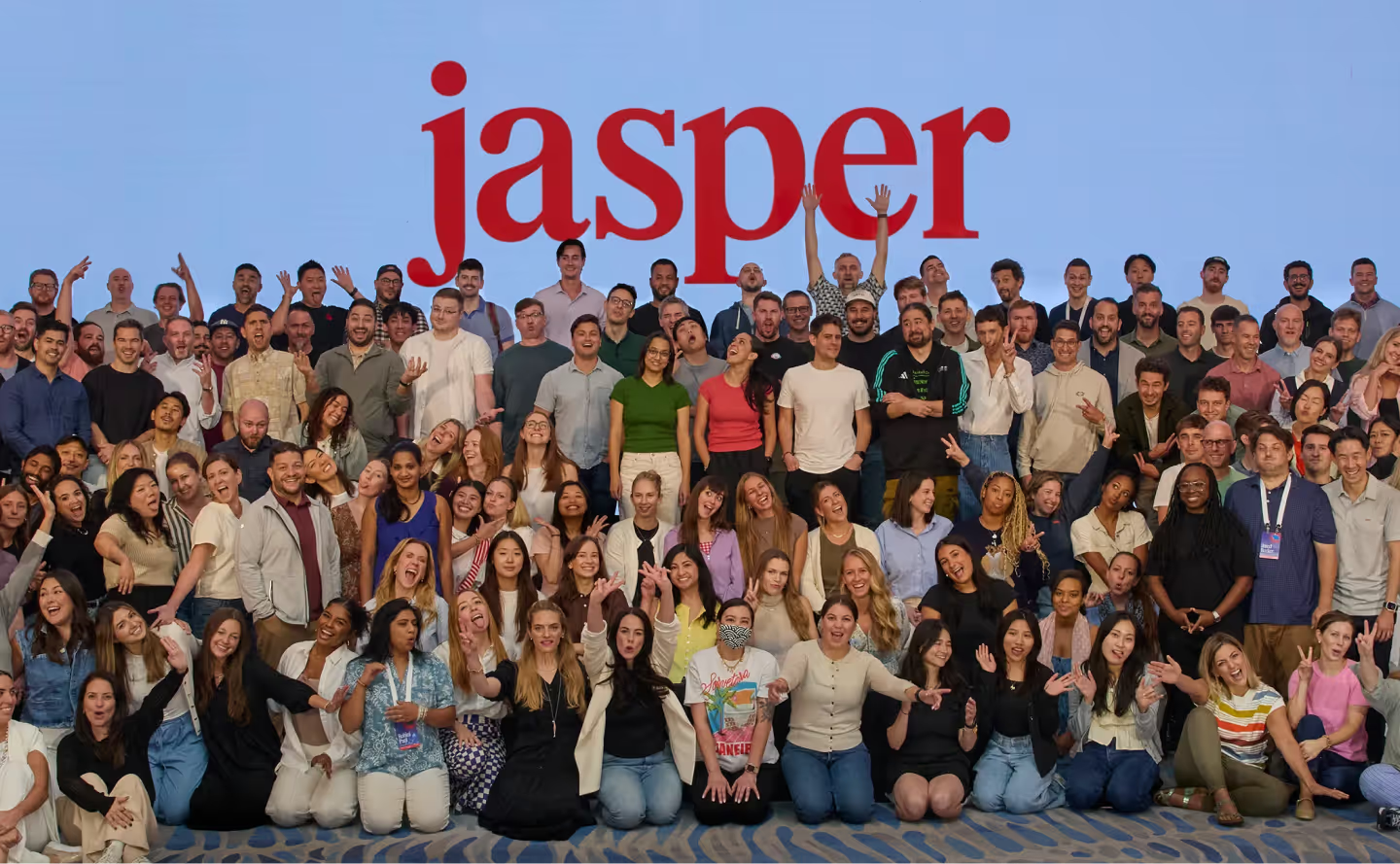
Reinvention in the age of AI with Patrick Schwarzenegger

+
%20-%20Flame.svg)
Replay
June 19, 2025 3:00 PM
EST
Reinvention in the age of AI with Patrick Schwarzenegger
Discover how embracing new mindsets can unlock growth and elevate storytelling to extraordinary heights.
You should be redirected shortly...
What we covered
Experience an intimate fireside chat with Patrick Schwarzenegger, hosted by Jasper at the iconic Carlton live in Cannes. Dive into a thought-provoking discussion on creative, professional, and technological transformation in an AI-powered world. Watch this intimate fireside chat with Patrick Schwarzenegger, moderated by Jasper's CMO, Loreal Lynch, at the iconic Carlton hotel live at Cannes Lions 2025 to discover how embracing new mindsets can unlock growth and elevate storytelling to extraordinary heights.
Full Transcript
Welcome and Introduction
Loreal Lynch: As Zach just said, I'm Loreal. I'm the CMO at Jasper. Jasper is the only agentic platform purpose built for marketing.
And I'm super excited to have you all with us this evening at this gorgeous venue, the Carlton Ballroom. I mean, it's absolutely stunning. So thank you for spending your evening with us.
And I'm even more excited for the conversation we're about to have with Patrick Schwarzenegger. Patrick is—he's really a story in rewriting the script. Every decision that he's made has been an intentional decision. From his early roles like Jock kid number three to recent standout performances like in the White Lotus. Any White Lotus fans in the house? All right. Patrick has really approached everything with meaning, with purpose, and has been very thoughtful about all these decisions that he's made.
And not only that, but you may not realize that in addition to being an actor, he's also an entrepreneur and an investor. He's co-founded the company Mosh with his mother, Maria Shriver, which is a brain health brand. We'll talk a little bit about that tonight as well.
And he's also invested in several kind of hot, better-for-you brands like Liquid IV and Poppy. So without further ado, I'd like to welcome to the stage our esteemed guest, Patrick Schwarzenegger.
Patrick Schwarzenegger on Authenticity and Career Growth
Loreal Lynch: So, Patrick, welcome to Cannes.
Patrick Schwarzenegger: Thank you for having me.
Loreal Lynch: Now, is this your first time at the Cannes Lion Festival?
Patrick Schwarzenegger: Yeah, first time at the Lion. I was here, whatever, two, three weeks ago for the film festival.
Loreal Lynch: Okay, cool. And what are your thoughts so far? Like, what are the differences between the two so far?
Patrick Schwarzenegger: This feels, like busier in a different way. Maybe it's just that at the film one, everyone was in, like, tux. In a suit and very dressed up, all fancy. It was a little bit more stuffy maybe, but this is a little more casual.
Loreal Lynch: We're pretty fun, right, guys?
Patrick Schwarzenegger: Yeah, like, so far it's been. It's been fun. I mean, it's been really busy here. Yeah, I've been bouncing around at different parties and different talks and conversations and.
And then even just downstairs talking with some of the people from your guys company about how it's kind of evolved and changed over the last decade, but specifically the last three years.
Loreal Lynch: Oh, yeah, yeah, totally. Well, so along those lines, you're making your Cannes lion debut. You've been to the Cannes Film Festival. You've also been to the Met Gala three times. These are sort of events that are cultural cathedrals that are meant for spectacle.
And so in these environments, how do you show up authentically?
Patrick Schwarzenegger: Oh, well, the Met is tough to show up authentically. It depends on what the kind of the theme is. You know, this year, with black designers and celebrating them, you know, it was important to go with a black designer, you know, and with Olivier and with going from Balmain.
And so with that, you don't necessarily have much say. You really rely on them and the designer and showing, you know, you're kind of the medium showing off their work and what their, you know, creations are. So it's not necessarily something I would wear every day, but it's, you know, it was still a great event to go to, and it was fun to collaborate with someone like that, but, yeah, it's hard, I guess, to go there and be authentic.
Loreal Lynch: What was the process like for kind of determining what you were going to wear?
Patrick Schwarzenegger: Yeah, I mean, Olivia gave me two different options of what he had thought and what he had designed. And the first one we put on, and it was perfect. For me, it's always about kind of pushing the envelope a little bit with the Met and doing something a little unique and a little different, but something that's not, I guess so, over the top, ridiculous.
But it was—yeah, it definitely pushes the boundaries a little bit. I mean, I held like a merse. A man purse.
Loreal Lynch: If you all haven't seen it, he looked amazing. You should look up the pictures online. It looked great.
Patrick Schwarzenegger: Yeah. So it's not my daily wardrobe.
Loreal Lynch: Well, have you ever felt in one of those environments, the feeling that you got it wrong?
Patrick Schwarzenegger: I mean, got it wrong? No, but I think that there's always the constant—I'm sure everybody feels a sense of, you know, am I—is what I'm doing correct? Am I doing what my boss wants? Am I doing what the director wants? Am I wearing the outfit? Do people like it? Do they not?
So I guess maybe it just boils down to fear. I don't think it's so much about—
Loreal Lynch: I mean, what was the question?
Patrick Schwarzenegger: Yeah, like, if you feel like you got it wrong and—yeah, exactly. It is about fear. I think everyone feels that. Everyone feels a sense of fear. Fear of failure. Fear of, you know, whatever that might be.
But I—yeah, I don't—doesn't equate to necessarily am I doing this wrong? It's mostly about, am I doing this to what the other person wants? I mean, I get that all the time, whether I'm in acting class or I'm doing something up on stage or you're doing a scene in a film, and, you know, immediately once you're done, your immediate reaction is, okay, I wonder what the director is going to think. He's going to come over, what is—know, I hope he likes it and stuff like that.
Loreal Lynch: So what's something that you do in those moments to stay grounded?
Patrick Schwarzenegger: I wouldn't say necessarily it's about grounded. I think it's more about preparation and, you know, your craft and your—the time you spend on doing your work. I've never had that before, someone in the audience listening to me. That was great. Thank you. I feel so flattered. Hit that, hit that like button and that follow button while you're at it.
Loreal Lynch: Okay, so let me switch gears.
Patrick Schwarzenegger: Oh, yeah. Preparation. So I guess how I go around that is just with the pro—you know, I've been equating it to a film project. You know, it's about doing your—being prepared, you know, knowing your lines, knowing who the character is and what you're wanting to establish and what you're wanting to achieve with that character and with that specific scene and your point of view.
And the more you know, the more comfortable you are, the more confident you are, the more competent you are. And then thus, you're not worried as much about, I guess, the failure of it. Makes total sense.
Loreal Lynch: So, moving to a different—a little bit of a different topic. Rob Lowe called you Mr. Zeitgeist, which is a pretty amazing title. If you had to rebrand yourself with a name that more reflects where you're going, what do you think you would choose?
Patrick Schwarzenegger: Gosh, how do I not sound like a braggart or—
Loreal Lynch: No, just say, just go with it. Go with it.
Patrick Schwarzenegger: Say Mr. Worldwide or something. I don't know. I have no idea what I would call myself. Any suggestions from the audience?
Loreal Lynch: Okay, we'll touch on that after. Okay, so the other thing I wanted to talk about is just some of the roles that you've chosen. So some of your early roles—I think one of the earliest ones was like, jock kid number three, right? You've had to sort of outgrow not just the type of roles, but also like assumptions about these types of roles.
And I'm just curious, you know, what's one perception that you think people still hold on to that no longer fits who you are just in terms of your career and how you've evolved?
Patrick Schwarzenegger: Oh, I mean, look, in the beginning of my career, probably in the similar vein of a lot of people in here with their business career or wherever you've started, you don't have much say or power of to where you want to go. I mean, you kind of—you start. So the jock kid number three, or the background actor, this or the, you know, those roles were minuscule. They're there. You're working one day, then you're working three days, and then you're working five days and then you get a better supporting role and then you, you know, so as my career has grown, you know, the work level and the prominence of the role and the prominence of the types of projects you get, those things continue to grow too. I mean, same way as, you know, when you're starting at a company, you're starting in the mail room or you're starting as the assistant or the junior assistant and then you're promoted and eventually you kind of—you climb.
And it takes time. You know, I mean, that's, I guess that's the big thing is it doesn't happen overnight, even with AI. I mean, you know, when I was talking with the CEO in the back and they were talking about how, you know, AI is massive now and everyone's talking about in the last, you know, 18 to 24 months, all the brands want to invest in it and they want to find ways to utilize it.
And he was saying how they were actually before OpenAI and they were, you know, back in 2020 when he had moved over to London and, you know, after with Dropbox and doing this. So it's been around. It takes, you know, years to kind of hit that tipping point and to people really understanding and viewing it on a widespread way. But, you know, this is my career. My acting career has been happening for, you know, 15 years. You know, White Lotus is just kind of that—it's for me, it's that tipping point where a lot of you guys get to watch my work. But, you know, I'm in class every week for putting up on stage in front of 20 people. You know, it's, you know, and it's all those types of small work moments that lead to a White Lotus. But, yeah, part of me wanted to rebrand and to be taken seriously as an actor and to be taken seriously that I'm—that I work in this and that I'm—that I'm maybe quote, unquote, talented in this and that I've—I've put the time and effort and energy to grow my career in this space, but I think also time helps that.
Loreal Lynch: So speaking of kind of your career progression and to where you are now, I just read an article in Deadline that you have a new project coming up. Would love to ask you to talk a little bit about that.
Patrick Schwarzenegger: Yeah, I—thank you. Yeah. I mean that—the, a lot of the story is under wraps, per se. I'm not allowed, except for I'm going to London this in August to film this with Margaret Qualley. It's an amazing, beautifully written, kind of romantic drama and it's being produced by Ryan Gosling and it's produced by Amazon, MGM.
And it's just a—it's a really beautiful love story and it's really cool to work opposite Margaret, who's had a tremendous year with The Substance and, you know, I'm a big fan of her, so. And it's cool for me to do a movie. I haven't done—the last five things I've done have all been series, so. Yeah, that's great. It's a cool switch up for me.
Embracing Change and Theater Experiences
Loreal Lynch: So, speaking of career, I want to pull on that thread a little bit. What's one moment in your career when embracing change felt risky but ultimately paid off?
Patrick Schwarzenegger: Well, I guess just probably my time going into theater was the most change of, you know, it's a totally different type of muscle, different type of filming experience. Well, it's not filming, but, you know, acting experience. It's something that takes up a lot, a lot, a lot of time.
But I think it's been the most monumental learning experience for me as an actor and grown the most from it.
Loreal Lynch: So say more about, like that decision, the decision point, like when you decided to, you know, to go into theater.
Patrick Schwarzenegger: I did it mostly by peer pressure by my acting teacher and coach. And also I did it because it was something I really did not want to do. It was something that I was extremely, extremely fearful of doing. I get extremely nervous with public speaking and with acting in general.
And so to get up on stage and to perform in front of the class of 25 people that you've never met before to me was like—the amount of anxiety I had before that was just ridiculous. And the first times I went up, I would—you could hear your voice talking, you know, like this and, you know, moving and you could feel your hand shaking and stuff. And just I think a lot of the times that happens, even on set, the scenes that you're most scared of doing, the most challenging ones, the ones you get most anxious about, most, you know, you're scared of, those usually tend to be the most thought provoking and the most moving for you as an actor and actually produce some of the best content for yourself.
And I think you grow the most from. So I guess for me, why theater and why those decisions were so important for me or I look back and I'm so thankful for is because it helps a) conquering a fear, b) gets over your fear of failure, c) it's helped tremendously with my public speaking. You know, I don't—I mean, I'm not really nervous being up here.
And d) yeah, it's just, yeah. Doing something that you don't want to do, I think is good.
Balancing Family Legacy and Individuality
Loreal Lynch: So one of the things that I love about your story is that obviously as you were just talking about, you've been acting for 15 years, you've worked very hard. At the same time, you're from a very well known family. So how do you kind of balance the sort of assumptions that come with being from a, you know, a famous family, but at the same time having your own individuality and intentionality?
Patrick Schwarzenegger: How do I deal with it? I mean, or just balance more like—yeah, I mean, you know, I'm constantly learning how to, I guess, balance it. People have always been interested in that, but now they're way more interested now that the show has come out and White Lotus has come out.
But it's—look, I mean, I feel extremely fortunate for the life that I've been given and the life that I've been brought up with and the parents that I've been brought up with, you know, from both sides. I mean, both my mom and my dad are very successful in their own rights and, you know, they've both worked tremendously hard to give me the life that I have and my siblings and, you know, I think that I try to learn from them and continuously work extremely hard for myself, not only to keep, you know, to make them happy and make them proud of me, but also just for your own self fulfillment. I mean, at the end of the day, I think what you learn throughout life is that you really have to be passionate about what you do and you really have to—it has to be satisfying to you and you really have to want to go out and do these things because ultimately you can't convince everybody of what you're doing. You can't convince everybody that you're good at what you're doing or whatever that might be.
So for me, I guess I learned over time to worry less about, you know, living in the shadow of my parents or being compared, you know, the idea of comparison, rather just try to focus on my own career path and what I really wanted to do. And I took a very different route than my dad with the roles that I've gone after or the body physique or whatever you want to say, but it's, you know, it's not—that path was not for me.
Loreal Lynch: So I want to touch a little bit on your parents and specifically your mom because you guys have this brand that you've built together, Mosh. It's a wellness brand. We actually, a bunch of us on the team had the bars on our flights over.
But talk to me a little bit about that venture. How did that come about? You know, because again it's, the thread here is, it's a very intentional decision that you made that kind of reflects purpose, the things that you care about.
So can you talk a little bit about that?
Entrepreneurship and Mosh
Patrick Schwarzenegger: Sure. Well, I guess just as I've been doing acting for 15 plus years, you know, I've done business. I actually went to school for entrepreneurship and a business degree and then got a minor in cinematic arts and theater.
So I actually—I've studied business and, and I've learned business per se and entrepreneurship from a very young age. And today my time is split between acting and business. Our business arm really just focuses on better for you health and wellness food and beverage products.
So anything that's offering the healthier version to the American consumer is where we play. And so it really started with me being a struggling consumer when I was 16 and I started to get into working out in health and wellness and I started to care about what I was eating and the nutrition fact panels and the ingredients and all these different things. I started to go out and look for the better version of what we grew up on.
And I was having a hard time finding it in the grocery store. And so I basically just created a very simple thesis which was I wanted to find the better version of what was out there, the healthier version. And so I went around looking for entrepreneurs that were tackling this and investing in their company.
So you know, Liquid IV was just the low sugar, you know, Gatorade or Poppy and Ollipop were the low sugar sodas, you know, Blaze Pizza was the more transparent, healthier Domino's and so on, so forth. You know, we have 15 plus, 20 plus companies under our portfolio. And then as time progressed, it was how do I, instead of investing in these other ideas and thesis, how can we build it from the ground up in house?
And so my mom had spent 20 plus years on research and development on Alzheimer's and in the brain health space. Father was diagnosed and she lost her father to Alzheimer's. And her main focus was to figure out what could prolong someone's brain health and their life, the life cycle of a brain.
And through that with the Cleveland Clinic, they focused on, okay, there's exercise is a tremendous factor, utilizing your brain communication, socializing. And diet. Diet is a huge thing about what impacts someone's brain both in a positive or in a negative way.
And through that research, she kind of said, you know what, I want to go out there and I want to build a mission driven company that educates people about what they eat, impacts their brain. I want to build a company that's mission driven, that raises money for Alzheimer's, but that can give back and provides the consumers with a product. And through my knowledge of the food and beverage industry, I just said, yeah, let me, I'll get that off the ground for you.
And so that's how Mosh was born. I mean, MOSH right now is a protein bar made for your brain. It has, you know, high amounts of protein, high amounts of fiber, it's extremely low in sugar, 2 or 3 grams.
And it has brain health nutrients in it. So it's got omegas and vitamin B12, vitamin D3, it's got ashwagandha and lion's mane, some functional mushrooms, it's got cognizant, which is citicoline. And it's proven to be—it's the only product, food product that has a claim that can be beneficial for brain health.
And then all while it raises money for Alzheimer's. So we've raised, you know, a couple hundred thousand dollars for Alzheimer's. And so that's how the product and the mission were born.
And that's kind of where we are today with it.
Loreal Lynch: And how long ago was that when you—
Patrick Schwarzenegger: That was during COVID. That was Covid. I think we launched 2021.
So four years.
Loreal Lynch: That's great. Anything that you would say because you're—you said you talked to our CEO, Timothy, and he's obviously an entrepreneur, but what are some kind of lessons that you've learned from just entrepreneurship? Because it feels like a, you know, and do you feel like there are similarities between that and the acting path, or do you think they're so distinctly different?
Patrick Schwarzenegger: No, I think that they're very similar. I mean, in the end of the day, I'm—you know, an actor is an entrepreneur in one way or another. I mean, you're still working for technically yourself, and you're out there having to carve your path and try to, you know, build your own business. I mean, I am a business in one way or another as an actor, you know, and I'm—at the end of the day, you're still selling, you know, just as Jasper's trying to sell their product and their AI and their services, I'm trying to do that as Patrick, you know, to Amazon or Paramount or Warner Brothers or whoever, you know, and I think that just like a business behind the scenes that takes years and years and years to build up, and then you have that kind of inflection point. It's the same there with acting and with that side of the career.
So I think that there are tremendous amount of similarities. I know from 10,000ft up, people think, how are you doing acting and business, it's totally two different worlds and so different. But it was actually my dad that really kind of pushed me to go into business at a young age and to go to school for business and.
And he always told me, you know, that he's made more money from business than he had from his film career and that, you know, his having a business background and how many people that he knew in the film industry or athletes or other actors that had made so much money but didn't know how to manage their money or the business side of their own finances and that had lost so much or were so dependent on the next role and, and so on, so forth. So I actually think that there's a lot of crossover and symmetry.
Acting, Business, and Investing
Loreal Lynch: So I want to switch and talk a little bit about your investing. You mentioned some of the brands that you've invested in, you're sitting in a room full of mostly marketers. We know how to put a good pitch together. How do you—but we're also, we're also all trying to build brands and cut through the noise.
So as an investor, when you're hearing pitches, how do you kind of understand and kind of cut through, you know, to understand where there's substance and where you really want to play?
Patrick Schwarzenegger: Well, for me, like I said, it was—I found my niche. I mean, I found what I was interested in. I was interested in finding the healthier, better for you products on all the areas of the shelves, whether it was in the cereal department or the pop tarts or the ice cream or the, you know, the bars or the, you know, cleaner, the dishwasher, whatever it is. It was just, for me, it was the healthier, cleaner version of what was out there in a large addressable marketplace. It had to be a large marketplace.
And that was very simple. I mean, when it came down to someone pitching their actual business, it really kind of depended on did I believe in them? Was it authentic, did I believe in the jockey, you know, behind the company per se? Was it a product that I would actually use and I enjoyed, did it have mass appeal? Could it travel across flyover states?
And was there a real kind of viable path for it to grow? I mean, I'm not some business savant. It's a very simple, you know, thesis in the end of the day.
And yeah, that's kind of what I would say. I mean, also know your audience. I mean, you know, with me, with Mosh, it's really about knowing our audience. We have, I would say, 70, I think 78% of our audience is 40 and above, which is complete, you know, opposite of a nutritional bar market. Usually it's very dominant in the 30 to 36 female range.
And so we attract someone that's different and unique and we aren't the sexiest company. We talk about brain health and body health and how you should eat for your brain and body and, and you know, we go after people that care about that which, you know, it's hard to get the younger audience to care about eating for their long term longevity or long term brain health when they think that they'll never have any, you know, brain problems or something. So I guess know your audience would be the—yeah, the big thing.
Loreal Lynch: Great, makes sense. And then not just with investing, but just in terms of brands in general. You know, in a world of cheap attention and sort of like sameness. A lot of brands today are starting to sound the same and it's something we talk a lot about. AI, especially as AI content picks up. We don't want everything to sound vanilla. It's important to maintain your authenticity and the uniqueness of your brand. What do you think, you know, makes a brand stand out and feel lasting to you? Is it instinct, story, team or something else?
Patrick Schwarzenegger: I mean, the story, I think is huge. I mean, team, yes. Culture, yes.
But I mean the team and, you know, they're the ones that are kind of helping bring the idea, the storytelling to life. But, you know, I mean, I think you could have an all star team, but if you don't—like in acting, I mean, you could have a bunch of A-list actors act their ass off. But if you don't have a great story, could not work. Or you don't have a great CEO or a great director, that great showrunner that's leading the charge, or you don't have, you know, or if it's just not a good product. Yeah, I don't know.
So I mean, I guess everything counts, everything adds up to it. But yeah, I think that authenticity is huge today with brands. I think it's pretty easy. You know, the consumer and the customer have grown quite smart and intelligent, especially through social media and through all these different lens. They can easily tell when a celebrity slaps a name onto a brand versus when they build something that's very authentic to what they are enjoying or what they like or what they need. You know, and I just did a conversation with Emma Chamberlain who had done a coffee company, you know, and it's doing extremely well. And, you know, I think that there's probably a lot of business advisors or people that would say, hey, we have got the attention of all these young people. Let's go after, you know, doing a makeup or go and do a, you know, this company or that company.
And she went after something that she loves, which is coffee. And I think that her followers or, you know, people that are consumers can tell when it's really, you know, authentic and it's something that needs to be out there versus just another brand that's trying to be, you know, glitzy in the moment.
Building Authentic Brands in the Age of AI
Loreal Lynch: And I love how, you know, speaking of authenticity and with your own company Mosh, I feel that you and your mom bring a lot of that authenticity into your, like the marketing that you guys do on your social channels. So can you talk a little bit about that too? And if you guys haven't checked him out on the socials, you definitely should.
Patrick Schwarzenegger: Yeah, I mean, it's extremely authentic and real for us because, I mean, it's, you know, we've both dealt with someone with Alzheimer's and obviously, like I said, my mother lost her father to Alzheimer's and she's been in the research space for this for 20 plus years. She runs the women's Alzheimer's movement, which is partnered with the Cleveland Clinic. So once again, it was all—we had the mission and the story and everything.
And then it was, we had the why and then it was really focusing on the what after that and making sure that we had that component down. And, you know, that's—I truly believe Simon Sinek has done a really beautiful conversation about the why versus the what. And companies that focus on the mission and that have that overall statement and that vision and the why they're created versus the ones that are all product driven and just the what and the difference between the longevity of the two different types of brands and he uses examples. It's a really beautiful, you know, difference between the two.
And for us, it's extremely important to be mission driven and to have that authenticity in that story because we're not a, you know, our goal is to be a B corp and to be a company that is, yes, it can make money and it can profit, but it's doing something that's better for the world and that's really built upon a mission, not trying to extract the most amount of money possible. So if I was just focusing on, you know, trying to be the coolest, most profitable, I would not go into the bar space. Yeah, it's not fun.
Advice for Marketers and Brand Builders
Loreal Lynch: So my last question for you was going to be what advice do you have for all of these, you know, marketers in the room as they are building their own brands? But I've heard just in our conversation two solid pieces that I know I'll take away from this, which is one you said know your audience, two what you were just talking about, about storytelling, having a really compelling brand story. Anything else that you, you know, any other advice you would give?
Patrick Schwarzenegger: I know you did a good job there. I would say, yeah, I mean, the only other piece of advice I guess from my side is just that it takes time, some things take time, and that, you know, overnight successes or things of that nature are hard to come by. And that I think that, you know, compounding, you know, year over year of the amount of work that you're putting towards your business or your marketing, your idea or the AI, whatever it is, that if you really have a product market fit and you're growing it over time, that it will have that kind of that tipping point, that precipice of becoming something real.
Loreal Lynch: This is awesome. Well, thank you for that advice and thank you Patrick, for being here.
Patrick Schwarzenegger: Appreciate it.
Loreal Lynch: So we're going to go ahead and wrap our conversation, but thank you all for joining.
Patrick Schwarzenegger: Thank you guys.
Loreal Lynch: Yeah, thank you.
Audience Q&A
Loreal Lynch: We can take some, we can take a few questions. Patrick said he's open to any questions from the audience or—Patrick here. Let me run a mic.
Audience Member 1: Are you okay? I was going to ask you about launching your products. Obviously you've got your family and they're well known, but what's been the most effective way for you getting the word out? Like people use influencers, they use ads.
Patrick Schwarzenegger: Yeah. So I think the way we started was utilizing our own audience. How do we go?
And we push it out to our own followers. And my mom had an email list from her Sunday paper, it's called, which is her kind of online storytelling blog that she has every Sunday. So we went out through that and that was kind of the initial group that was kind of our, our hardcore followers, our, our early adopters.
And then as it's continued and we've looked to grow, it was okay, how do we do the, you know, Facebook ads, YouTube ads and so on so forth and, and paid media and then continue as the brand has continued to grow. We've looked at, you know, mountain and TV ads and YouTube and doing other forms of content, going on to podcasts, doing podcast advertising, email lists, so on, so forth. So it's kind of changed over time and obviously with a lot of your paid media you get to kind of learn what is working and what's not, you know, which ones, what, what customer acquisition costs are you having the least with, you know, a specific group of individuals.
And for us, like I said before, it was very much about finding that niche. And we were performing extremely well with kind of that really like 40 to 48 female was like where it was our, our hotspot which was against the grain of what they had kind of told us of who you should go after, you know, the 30 year old female and the young mom that was buying for the household and things like that. So I think that you probably even now with AI, you get to learn a lot faster and more rapidly.
So I think we'll continuously learn and put out new creatives and ways to continuously try to find new audiences at the best rate possible.
Audience Member 2: Thanks for sharing all your insights. I'm curious, you know, you've come from a family that's very successful and obviously that provides some advantages, but also provides a very high bar. And I'm curious, taking 15 years to achieve the things that you wanted to do, how have you been able to avoid getting discouraged when things are taking longer than you maybe wanted to or expected?
Patrick Schwarzenegger: Yeah, that's a good question. Yes, like you said, I mean, there's of course coming from, you know, the family that I have, like I said, in both of my mom and my dad's side. I mean, it comes with tremendous advantages. I mean really advantages and a bar that's set high and—but it also comes with comparisons or it comes with expectations or it comes with, you know, so many different things.
But I guess it would boil down to the idea of my own personal vision and the passion that I have for the fields that I work in. I think that it's very easy to get discouraged no matter what, but it's a lot harder to get discouraged if you are extremely passionate about the field that you're in. You know, if I were to go and launch an AI company tomorrow and it took me 10, whatever years, I would get discouraged because I'm not a, you know, I don't know everything about AI nor do I. You know, that's not the field that I want to be in or love, I guess, per se. I get fascinated learning about it, but I'm not the CEO to go drive an AI Jasper company, you know.
But with acting, I loved it. You know, I loved going up on stage and performing for 20 people week over week. I loved doing a small role in Grown Ups 2. To me, that was like amazing.
And then I loved playing a supporting role opposite Colin Firth on The Staircase and, and against, you know, everybody else on that show that had won Oscars and Emmys. And then I love doing White Lotus because it's—you're working. But then it's also something that gets seen by, you know, 20 million people and it's a massive show and it gets your name out there.
So I guess all that to say I love what I do and I'm not always focused on the end result, I guess I'm focused more on just continuously growing and getting better and I know that over time that compounds and hopefully one day I have that moment that I've—I guess I'm having, you know.
Audience Member 3: First off, thank you for answering all of our questions. Yeah, I think we're all really excited to talk about these questions together when afterwards as well. My question is centered more around what you see as a future of marketing. I think we're all really excited about how AI can empower us to make better decisions that are aligned with an authentic vision that we have for our companies. We also know there's going to be a lot of AI generated content and trying to suss out what's, what's real and what's not. At some point, what do you see as a futuristic marketing channel for you to stay in line with how you can authentically show up and share your vision with your prospective and current customers?
Patrick Schwarzenegger: Yeah, I mean, to me it's kind of looking at AI. How does it help? I mean, how does it complement what we're doing already? You're not—not right now fully supplementing. I mean, you know, I'm not at the point, and I don't think AI is at the point where I would just fully let it go and market to my customers. I mean, at the end of the day, you have to have the human emotion that connects with your customers because that's what they're looking for. They're looking for that authenticity. They're looking for the why, they're looking for the connection.
And for me or for my mom to just push it off, it just wouldn't make sense. So, you know, we're built based on our story, people like the mother son duo. We continue to utilize ourselves to market, but to also push out the mission.
And I guess if I were to look years in advance of how AI would help—oh, gosh, I don't know. I feel like every other month there's a new way that it's helping or that it can help. So I don't necessarily know except for the fact that it's—I would think that it just makes things, you know, more streamlined and easier and being kind of that helpful hand, but I don't know.
Loreal Lynch: Yeah, well, that's, I guess that's true. I mean, it will never take over in person, in real life experiences like this. I think we have time for one more question. Sorry.
Audience Member 4: Hi. I was just so curious because most of us in the room, we have one full time job. It seems like you have two. You know, you're an actor, a very successful actor and you also are an entrepreneur.
So how do you balance both, especially with your family and friends and all of the things that we're all trying to do in our regular lives. So I would just be very curious, how are you doing both? Maybe AI is a part of it.
So that's my question.
Patrick Schwarzenegger: It's a great question. I think, you know, first off acting, it goes in ebbs and flows. I can be working every day for seven months in Thailand like last year and then I could not work. You know, I worked what—I started first week of February, I ended the last week of August.
And I wasn't back on set until this August. I mean, yes, I was—we were out promoting the show for the past three or four months and stuff. But it goes up and down.
So it gives me plenty of time to work on other areas of my life that I want to work on, whether that's my significant other or my, you know, friends or my family or my business. The other side of it, I think you asked how do I manage day to day life or the other aspects that we all try to manage. The answer is that that takes a hit. There's no way really around it. I mean, you know, it's, I'm very fortunate that I have a partner that is, you know, my partner that believes in my goals and the dreams that I want to do and I believe in hers.
But I mean, yeah, there's times last year where, you know, I didn't go for seven months without seeing family or friends. You know, I'm out doing what I want to do and I want to build my career and the choices that I want to do. And that's, that's part of, that's part of it unfortunately, but also fortunately.
And then I think there's always kind of like, how do you look at things? Because for me it was, wow, I can't believe I get to go to Thailand. And I—no other time in my life am I going to go and pick up and move to Thailand for seven months.
And then you kind of become friends and family with the people that you're working with. I'm sure in the similar way that you guys all go to—well, actually you guys are, a lot of you guys are remote, right? So I don't know, maybe you're with your family way more.
But when I—my first job is when you would go to your office and you would meet the people and interact with the people that you did, and you become friends with people in the office, and those are the—you know, that's how that goes. But I think whenever you're chasing your dreams and you're, you know, an entrepreneur, you know, it's—you're working for yourself, and it's—the amount of input you're putting in is a lot of the time dictates what kind of the output is. And, you know, that's why a lot of times entrepreneurs are crazy and, you know, they have a wild vision, and it takes a lot of sacrifices and time to go in and pursue those dreams.
But I would say those are some of the most important things of my life are my friends and my family and my faith, and those are the things that stay constant around me as my career goes up and down.
.png)

.png)
Table of contents
- Welcome and Introduction
- Patrick Schwarzenegger on Authenticity and Career Growth
- Embracing Change and Theater Experiences
- Balancing Family Legacy and Individuality
- Entrepreneurship and Mosh
- Acting, Business, and Investing
- Building Authentic Brands in the Age of AI
- Advice for Marketers and Brand Builders
- Audience Q&A
More webinars & replays
September 10, 2026
September 10, 2026 12:00 PM
EST
From Insight to Action: Why Marketers Need Agents to Win AI Search
Jasper CMO Tom Newton sits down with Raakhi Agrawal and Robert Derow of BCG X to break down why you need agents—not just insight—to win AI search.
Hosted by



Raakhi Agrawal
Managing Director and Partner, BCG X
Robert Derow
Managing Director & Partner, BCG X
August 13, 2026
August 13, 2026 12:00 PM
EST
Meet the GEO Agent: From Insight to Action, Automatically
GEO isn't one task. It's hundreds of them, repeated continuously as AI answers shift and competitors move—and a citation you win today is no guarantee you'll hold it next week.
Hosted by

Kurt Lambert
Senior GEO Strategy Manager, Jasper
Megan Johnson
Director, Product Strategy and Operations, Jasper
April 30, 2026
April 30, 2026 12:00 PM
EST
AI Tools Don't Scale, Systems Do: Bonterra’s Approach to Content Orchestration
Most marketing teams have solved content generation. The real challenge is orchestration: building repeatable AI systems that scale output, cut cycle times, and keep quality consistently on-brand.
Hosted by

Neil Grasso
Customer Advocacy Marketing Manager, Bonterra


Steve Kearns
Sr. Director, Customer Evangelism & Community-Led Growth, Jasper
Put AI agents to work, on your terms
Explore how Jasper agents help teams turn strategy into execution across every channel, market, and audience.




- © 2026 Jasper AI, INC.
- Privacy Policy
- Terms of Service
- Legal Center