- Log In
- Free Trial
- Get A Demo
GEO & AI Optimization
Win the new front door of search
Measure how your brand performs across every major AI answer engine, prioritize the actions that matter, and ship brand-governed content at scale.






GEO Diagnostic
Learn what AI is saying about your brand, where the gaps are, and what governs the brands AI cites instead.
Brand Compliance Diagnostic
Scan your website and public content to learn how consistently you score for brand governance and compliance.
AI Meets Personalization, a Conversation with McKinsey in Cannes

+
%20-%20Flame.svg)
Replay
June 16, 2025 11:00 AM
EST
AI Meets Personalization, a Conversation with McKinsey in Cannes
Explore how enterprise marketing teams are effectively driving personalization at scale with AI-powered strategies.
You should be redirected shortly...
The Webinar Replay recording is coming soon.
Fill out this form to get the recording when it's ready.
Missed the webinar?
Fill out this form to watch the replay.
What we covered
For years, marketers have worked hard to make personalization a reality, often hitting roadblocks along the way. Manual workflows, limited insights, and the pressure to connect with various audiences in a meaningful way left even the best teams coming up short on true, one-to-one engagement.
Now, marketers have new technology on their side, opening up a whole host of questions: How is AI reshaping personalization? What does it take to balance scale and relevance? And how can marketers use AI in a way that unlocks their true potential to create meaningful connections?
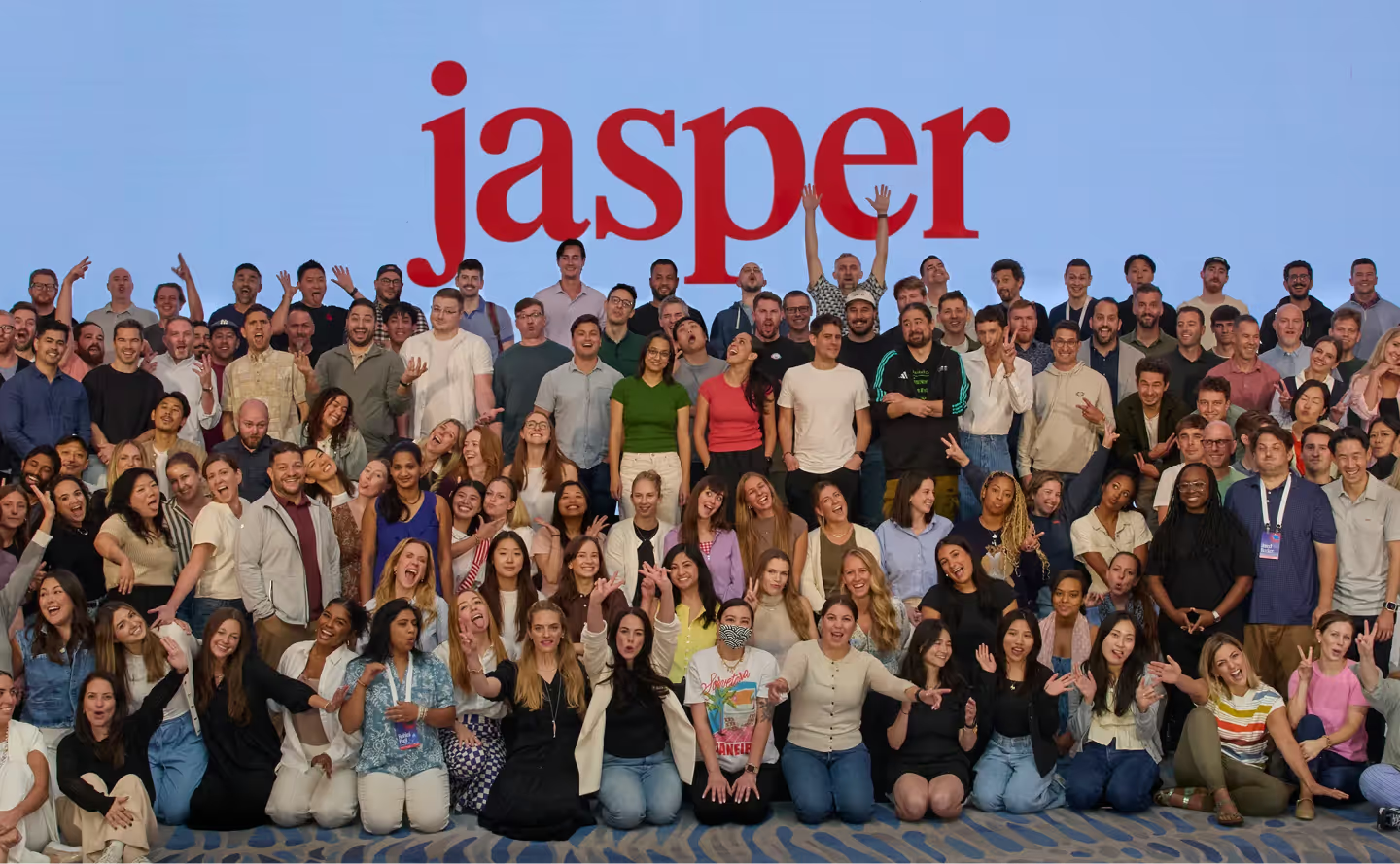
Explore these pressing questions and more in a fireside chat at the Jasper Cabana at Cannes Lions 2025. Eli Stein, Partner at McKinsey, and Loreal Lynch, CMO at Jasper, discuss insights on how enterprise marketing teams are effectively driving personalization at scale.
In just 20 minutes, learn:
- How the latest AI advancements transform personalization from a game of "Mad Libs" to creating inspiring content at scale.
- The critical role data-driven insights play in building personalized campaigns that cut through the noise.
- How to rethink workflows to seamlessly integrate AI and unlock efficiency, creativity, and growth.
- An example of how leading brands already use AI to enhance both customer experiences and marketing ROI.
See how AI can transform your approach to personalization and human connection. Access the on-demand session now.
Full Transcript
Welcome and Introductions
Loreal Lynch: Hello, everyone. Thank you for joining us today. I'm excited to be joined here by Eli Stein, partner at McKinsey. Eli works with a number of CMOs on their AI transformation journeys. And we're excited to be here today to talk about personalization and what's new with personalization and what it, what it is now in an AI world and how it's evolving. I'm Loreal Lynch, by the way. I'm the CMO of Jasper. But Eli, maybe you can just start by giving a quick intro of yourself and your role and what you've been up to at McKinsey.
Eli Stein: Of course. It's great to, great to meet all of you. I'm Eli, based out of San Francisco. I've been at McKinsey about 15 years and I've spent, call it 10 of the past 15 focused on data driven marketing. I serve CMOs on growth topics driven by data. My background was in theoretical statistics before McKinsey. And as you can imagine, the past two, three years have been all about generative AI, really building on the years before that, which were all about discriminative AI. I've seen a lot of CMOs really drive a lot of acceleration. Also a lot of CMOs fall into trapdoors. So happy to share those experiences with you all.
Loreal Lynch: That's awesome.
The Evolution of Personalization in an AI World
Loreal Lynch: Well, I wanted to just get started by asking a question that I know we've talked a little bit about, but the notion of personalization is not new. I feel like it's a promise that's been getting made to us as marketers for the last decade. And now I feel like it's having a moment again with the rise of AI. Everyone here is talking about personalization and personalization at scale and how AI unlocks that. So, Eli, my question for you is, what do you think is different this time around?
Eli Stein: Yeah, that's a great, great question. You know, I think of personalization over the past, call it 10 years as Mad Libs. So the childhood game, right, where there's a story or with blanks and you fill in the blanks, that's been tremendously effective in some cases, right? Think about recommended movies, recommended products, et cetera, where the more specific you can get something, the better. And that's really where machine learning and discriminative AI have been very helpful. At the same time, it's almost depersonalized in a way. And if you think about all the things that as marketers we try to do, be inspiring, be educational, make someone's life more convenient while being relevant and authentic MadLibs have really taken away from that. I have one client that is a large multi SKU retailer, millions of SKUs, and they used to send out a weekly email with curated recommendations. And they had tens of versions of this email with different categories based on what people would want to buy. And the content around the email was very engaging because they embedded it with, you know, interesting components about the category. They moved over time to really sophisticated machine learning where there would be nine product recommendations entirely related to you because they had so many millions of SKUs that they were sending 600 million completely unique emails each week with these product recommendations. Think about making content and writing a subject line for 600 million unique emails. Right. So they evolved to something so generic, like stuff you'd like. Right. Because it's just impossible. So at the same time, what they were filling into the Mad Libs was so specific, but it completely dethroned what they were trying to do around being inspiring around that category. And that is what AI enables, is it enables you to produce content at a scale where you can be inspiring, be relevant, be educational, as opposed to just filling in Mad Libs. And that's what I think the next horizon of personalization will be. That is really fulfilling the promise we all wanted, you know, 10 years ago when we started to personalize.
Loreal Lynch: Absolutely. So I always say the hardest thing about using AI in marketing is making it look like you're not using AI in marketing. And I think a lot of us who have an eye for it can spot it a mile away. You can see if there's a too many EM dashes or if things sound. You just use the word generic. And so I think one of the pieces about scaling personalization is also not just creating more content and filling in the MAD Libs, but how do you make it truly resonant? And I think the resonance is such a key piece to unlock. And one of the things that I think comes with that is before you can even create and scale content, you need to know and understand your audience and. And you need to have kind of the data that, you know, that brings that to you. So do you have any kind of examples or thoughts on that piece? I know McKinsey's done some research along these lines.
Eli Stein: Yeah, of course. So, you know, if you think about the fundamentals of personalization, you know, first it's knowing an audience, knowing their needs, then it is identifying data that can give you contextual information because marketers are always responding in a moment, and then it's ultimately production. And I think where some folks have gone wrong with AI is being thrilled by the capabilities to produce at scale, which is great, right? But in some sense it is the tail wagging the dog in personalization. And you have to understand your audiences and micro segments, you have to understand the data triggers to find the right moments to respond to them. And then of course, you have to be able to produce at scale. And the ability to produce at scale is what's unlocked by AI, which is fantastic. But without understanding the audiences, prioritizing the audiences, and then understanding the contextual data that can help unlock the moments where they're influenceable, then you're just putting, you know, putting muck out into the world.
Loreal Lynch: Amazing.
Unlocking Scaled Personalization Workflows
Loreal Lynch: Well, so you talk to, you talked about a couple of examples of kind of scaled personalization workflows and just a quick plug. Eli and I also did a webinar back in December on scaling AI workflows. You should, should check that one out too. But I want to pull on that thread for a minute because there's the scaled workflows, which, which is what everyone's North Star is. But the reality is, according to our research, we did like a state of AI and Marketing report earlier this year, the majority of marketers, while they are adopting AI, are still using it in very ad hoc ways. And so what do you recommend, as you know, the next steps or what needs to happen in an organization in order to go from sort of like an ad hoc personalization use case to creating a full workflow for personalization at scale in order to really unlock that ROI?
Eli Stein: Yeah, our research says similar things. So we do an annual survey of CMOs. Two years ago, people were excited about AI. They were dabbling in it. 80% had not done anything beyond being excited. You know, this year what we found is almost that same 80% is deploying AI in individual point use cases, not longitudinally throughout the journey. And that is really the unlock for companies that have delivered value at scale. For folks deploying AI at point use cases, we've seen single digit cost savings, some growth from personalization, nothing more. When we see companies that are really successful, they're doing three things. They're rethinking the workflow, they're rethinking roles, they are making AI interoperable. And then overall, you could call it a fourth, they are building incredible capabilities. So if I take those in turn, the workflow changes with AI. So if you just put AI in your existing workflow, for instance, you have multiple steps to review creative that are two way doors, you are going to go no faster or marginally faster than if you didn't have AI in the first place, because the same steps are just going to slow down the gears. Secondly, in a world of AI, the roles are fundamentally different and it's a paradigm shift, right, of thinking of AI as this very cool tool to AI is, you know, catalyzing a new era of marketing. So things like going from a content director to a modular content manager, right, someone who's not looking at individual pieces of content with a discerning eye to someone managing all the different modules of content that AI will then reassemble. So that is the, you know, the roles component, then the interoperability component. You know what we see really, really harming marketers and is AI being another tool that you need to swivel chair into, right. If your AI content production tool is not connected to your DAM, is not connected to your CMS, isn't integrated with briefing, etc. Your marketers are really going to struggle to adopt it just because it's human, human nature, right. And then finally, you know, employees and employers alike have a spectrum of emotions as it relates to AI. And some employees have had the moment of holy smokes, this can really accelerate my capabilities. Others are still fearful, reticent, et cetera. And the companies that have been able to find those inspired moments for the majority of their employees and train them how to use these tools to make them better are worlds ahead from the companies that give tools to employees and say now go use them.
Loreal Lynch: That's great. I was was recently reading a Gartner report that says they basically said that those struggling with AI adoption are those who struggle just broadly with tech led disruption in general. So it's not really specific to AI, it's just all the new technology.
Eli Stein: Yeah, I think that's exactly right. What we see as being different with AI than some other forms of technology is the degree to which it's shifting rates of working. You know, if you think about in marketing, right, the shift from quote unquote traditional, the shift to digital, the advent of social, that's, you know, meaningfully changed what marketers have done. It hasn't as in that big of a way changed how marketers work. So this is almost less of a disruption in the form factor, more of an unlock as to what we're able to produce. As long as you can work in a very different way.
Loreal Lynch: Yeah, that's a very strong as long as. And so the part that you mentioned on rethinking the workflow from the ground up in an AI first way. We talk to our customers about that a lot too and I think a lot of times people struggle with that because they've never had to do that before. Things have always been, I mean there has been, like you said, social media and there's been Internet wave. But how do you work with customers and what are your kind of best practices on like within the organization, how to do that, you know?
Rethinking Marketing Workflows for AI
Eli Stein: Yeah, look, there's two trap doors that you can fall into. The first trapdoor is putting blinders on and saying I'm just gonna use these tools and not change my workflow at all. Not a good thing to do. That one, that one's kind of obvious. The second trapdoor is to say at some point my whole marketing team is going to be autonomous self organizing agents and until that's the case, I'm not going to do anything. Also a trapdoor, right? Because we're not there yet and we'll see when we get there. But it doesn't make sense to wait. The best practices for changing the workflow are a couple fold. First is having a really good understanding of how the workflow actually works today, which many marketers don't do. You know, if you have a 1000, 2000 FTE organization with a whole host of agencies, the actual intricacies of your workflow are very hard. So first you've got to understand you know, what it is. You've then got to reimagine what the workflow could be and that should be a derivative of the type of marketing you want to do. So let's say you're the company I mentioned earlier that has 600 million emails weekly, awesome ML based recommendations, really poor overall inspiration, look, feel, etc. The workflow to produce that is going to be meaningfully different than a company who wants to, let's say, do a great mid funnel activation of 15 second, you know, pre roll spots on social. So the second thing is to figure out, you know, what you want to do in marketing. And the third thing is to reimagine your workflow from the bottom up. There's a couple, you know, truisms, right? You're going to want to have more modular content than you have today. You're going to want to have agents making some decisions that you make today. Like does it pass the first level of legal and compliance after that it is a reimagination that looks very different for many other companies. There isn't a really strong blueprint today. And the biggest advice I give to people is don't not do that. Right. You need to take the moment to reimagine the workflow before you expect different results. And then downstream of the reimagination, there's rearchitecting the workflow, re engineering how your people work, et cetera. But the most important thing to do is to realize that now is the time to re architect your workflows, have it be a function of the type of marketing you want to do and make it be one of your top priorities as a CMO.
Loreal Lynch: That's great. Kind of a follow up on that is like there's, you know, we all talk about changing consumer expectations and now at this moment there's also a lot of economic pressure and I think that drives a little bit of urgency within organizations to not just think of personalization as a nice to have. But what do you think about personalization as a differentiator?
Eli Stein: Yeah, look, I think for a long time personalization has kind of been, you know, the sprinkles on the ice cream or the, you know, the ketchup on the burger of whatever, whatever your analogy is right. Personalization has really not been a tool to increase relevance and authenticity largely because the costs of producing content at that scale were just cost prohibitive. Right now I think we are in an era where personalization can really increase the relevance and authenticity of how you connect with consumers. If you start from an audience back data back lens, think about the 4,000 dialects that are spoken in India. Soon we'll be in a world where if you are a global company not talking to all those folks in their native language, you're just not going to be able to compete with the folks who do so. Our research shows that 75% of customers are turned off by content that doesn't seem relevant to them and the bar for that relevance will keep increasing. So our biggest advice is previously if you were sending an email to engaged customers and your recommendations were okay, not great, you're probably fine. You know, these days if you're sending something that's not relevant, not authentic, it is really going to stand out as not not for me and therefore not selected by a consumer.
Personalization as a Differentiator and Measuring Success
Loreal Lynch: So when I talk to a lot of marketing leaders and particularly CMOs, I find that they are anchoring. There's a particular value driver that they're anchoring on. And it could be, you know, brand is super important. Like I'm trying to like, you know, have brand consistency across touch points or in some cases, I just talked to someone yesterday who for them it's customer experience. Like we're, we're really trying to like deliver a great customer experience. That's a brand differentiator. Sometimes it's revenue growth. I'm a growth CMO. I only want to, you know, they only want to drive growth. And then in some cases we talk to companies where they're like, we're really tight on budget right now, we can't hire. It's about efficiency. I feel like personalization can help with all of those things. What do you see as kind of the most common metric or way of, you know, way that CMOs are wanting to measure this?
Eli Stein: Yeah, you know, it's a bit of everything all at once. Right. Most CMOs these days have a really complicated mandate which is drive growth amidst increasing competitive intensity. Start to be, you know, the CMO that is as close to the CFO as you are to the CEO. All while, you know, being closest to the customer and democratizing that knowledge. So for personalization specifically, you know, most folks tend to be focused on growth, but the majority of, majority of companies that are using AI, well for marketing essentially have a three part focus. And it's not not rocket science. Number one is external efficiency. How do I use these tools to interact better with an ecosystem and make it more, more efficient, Think agencies, et cetera. The second is unlocking the human potential of my organization. Marketers didn't become marketers to facilitate a process, but that's what the majority of marketers do. Right? Marketers become marketers to shape culture and commerce. So how do I use these tools to help unlock why people became marketers in the first place? And third is to drive growth. And I say it's not rocket science because if you were to, you know, 15 years ago say what are we trying to do as marketers? I mean that's a pretty good answer for it, right? We want to be efficient how we operate, we want to unlock the tools of our teams and we want to grow. I think the challenge for marketers these days is using AI to do all three of those things. Some may be more important for different companies depending where they are in their lifecycle, but we see AI to be very relevant for all three.
Loreal Lynch: That's great. And then so I agree growth is probably the main, you know, and along those lines I think, you know, we think of personalization, we think of it as a marketing problem to solve, but the reality is it's actually quite cross functional. So if you think of like growth, for example, you have to work very closely with the sales organization. How do you see effective organizations managing that sort of like collaborative process as they tackle personalization?
Cross-Functional Collaboration in Personalization
Eli Stein: Yeah, personalization, especially AI driven personalization is inherently a cross functional exercise because it cuts at the core of the value proposition as a company, you know, we have seen, call it an alliance of three, right. It is marketing technology and its product. And you need all three to drive personalization these days. First of all, personalization is extremely tech powered. Be it called the, you know, old tech tools, your DAM, your CMS, et cetera and then the newer AI driven tech tools. Second, if you are personalizing, absent what product is doing, you know, you're fighting with one hand tied behind your back and as you think about the feedback loop of what you're learning from which messages resonate, oftentimes the implications of acting on that are a product motion. So that's called the group of three that we see to be extremely important to drive personalization. There's a whole host of allied functions that have to be very closely next in line, right? Legal and HR are the first ones we see especially around AI and changing the roles of how humans are interacting with machines.
Loreal Lynch: That's awesome. Well, I've got one more question that's a little more fun, which is you work with some of the world's top companies, you work a lot on personalization. Can you share some use cases with us or have you ever seen something where you're like, that's cool?
Innovative Use Cases in Personalization
Eli Stein: Yeah, of course. So I'm happy to share. Share 2. We respect the confidentiality of our company, so I won't use names except for the first one, which I can. So has anyone flown through the Detroit airport recently?
Loreal Lynch: No.
Eli Stein: That's okay. Okay, so there's a. So taking a step back. So pixels that display light, right? Most pixels display light, the same beam of light in all directions, right. You know, thousands, millions of directions. There's a new technology called multi view pixels where it can display different light in different directions. Now the implication of that is that if I'm looking at a screen like this and someone else is looking at a screen like this, you can see actually entirely different things. I could see a bear, you could see whatever, a walrus. So this screen in the Detroit airport, it's real, you can go and see it, you give it permission, you allow it to scan your face and it will display your flight information on the screen different for everyone and it will follow you along. I'm walking and I'm seeing my flight information. You're walking and you're seeing different flight information. Now that's kind of a toy, right? Because you can see your flight information right on your phone. But think about the implications for the tens of billions that are spent on out of home marketing every, every year, right? And even whole stores are a billboard, right? So you know, McDonald's is oftentimes a billboard for the CPGs it works with, right? This is an entirely new way of thinking about out of home marketing. Now that one's a bit on the kind of forward leaning edge in part because that technology right now is too expensive to scale. But um, that is where we see things going. And then when you think about the contextual information that, you know, humans have your heartbeat, your level of physiological arousal, right? Think about how I want to be treated in a moment versus you. You know, we're all hot in the south of France. What we want to see now is probably different than the person back in their hotel room in, in the air conditioning. And the ability to generate content in the moment of consumption is going to totally change the paradigm of how we interact with customers. Now that's, you know, a couple of years out. If we think about a really cool example of what a company is doing now. This is a company that makes food that you can buy in restaurants. So food you can buy alongside a meal, they, you can get it in a number of places. They do less well in restaurants than they do in other places. And the reason they do less well in restaurants is they're kind of getting squeezed by healthier options and more premium options. And folks that go to a restaurant either trying to be healthy or they want to treat themselves, so they're kind of stuck in the middle. So what they do is the thesis was if we could geo target folks that are about to walk into a restaurant and show them how our food better pairs with a meal, we are going to have a higher selection rate in restaurants. So if you go to a restaurant, you and you are in a certain radius within walking distance, you're moving at the speed of walking, right? So you're not like driving by on a freeway. You will be geotargeted with an AI generated image of one of the popular meals from that specific restaurant. Not kind of any general meal with their food next to the meal and it changes based on the contextual weather, right? So if you are somewhere where it's cold and it's raining, you know, the meal that it shows this product next to is going to be appropriate for that weather, you know, a soup, tea, whatever it is, versus if you're here and it's hot, you know, maybe next to, I don't know, a smoothie. And as you can imagine, that has dramatically increased their selection rates in those restaurants. Because you go into those restaurants saying, oh, like this would pair great with this, this, this other meal that's so cool that you know, that is, by the way, entirely possible with today's technology. Right. And, and when we think about that's not even all that advanced. Right. You're not even personalizing really to an audience and you're not really understanding their needs. You're personalizing to a location. But as you think about what's possible with AI, think about taking that to understand the unique people, their context and the data they're generating. That is so much more powerful than so much of the social marketing today, which is this thing, this thing exists. And that's how we see AI and personalization unlocking the next frontier of marketers doing what they always wanted to do, which is to educate, to inspire and to be relevant.
Loreal Lynch: That's an awesome example. Very cool stuff.
Closing Remarks and Thank You
Loreal Lynch: Well, I think we're going to end on that note. Appreciate your insights today as always, Eli. And for those of you here, stick around, we have in the spirit of personalization, some custom embroidery set up outside so you can pick up a bag or a scarf or a hat and get it custom embroidered right outside here. But thank you so much for joining.
Eli Stein: Thank you all. Nice to meet you.
.jpeg)

.png)
.png)
Table of contents
- Welcome and Introductions
- The Evolution of Personalization in an AI World
- Unlocking Scaled Personalization Workflows
- Rethinking Marketing Workflows for AI
- Personalization as a Differentiator and Measuring Success
- Cross-Functional Collaboration in Personalization
- Innovative Use Cases in Personalization
- Closing Remarks and Thank You
More webinars & replays
September 10, 2026
September 10, 2026 12:00 PM
EST
From Insight to Action: Why Marketers Need Agents to Win AI Search
Jasper CMO Tom Newton sits down with Raakhi Agrawal and Robert Derow of BCG X to break down why you need agents—not just insight—to win AI search.
Hosted by



Raakhi Agrawal
Managing Director and Partner, BCG X

Robert Derow
Managing Director & Partner, BCG X
August 13, 2026
August 13, 2026 12:00 PM
EST
Meet the GEO Agent: From Insight to Action, Automatically
GEO isn't one task. It's hundreds of them, repeated continuously as AI answers shift and competitors move—and a citation you win today is no guarantee you'll hold it next week.
Hosted by


Kurt Lambert
Senior GEO Strategy Manager, Jasper

Megan Johnson
Director, Product Strategy and Operations, Jasper
April 30, 2026
April 30, 2026 12:00 PM
EST
AI Tools Don't Scale, Systems Do: Bonterra’s Approach to Content Orchestration
Most marketing teams have solved content generation. The real challenge is orchestration: building repeatable AI systems that scale output, cut cycle times, and keep quality consistently on-brand.
Hosted by


Neil Grasso
Customer Advocacy Marketing Manager, Bonterra


Steve Kearns
Sr. Director, Customer Evangelism & Community-Led Growth, Jasper
Put AI agents to work, on your terms
Explore how Jasper agents help teams turn strategy into execution across every channel, market, and audience.




- © 2026 Jasper AI, INC.
- Privacy Policy
- Terms of Service
- Legal Center