- Log In
- Free Trial
- Get A Demo
GEO & AI Optimization
Win the new front door of search
Measure how your brand performs across every major AI answer engine, prioritize the actions that matter, and ship brand-governed content at scale.







GEO Diagnostic
Learn what AI is saying about your brand, where the gaps are, and what governs the brands AI cites instead.
Brand Compliance Diagnostic
Scan your website and public content to learn how consistently you score for brand governance and compliance.
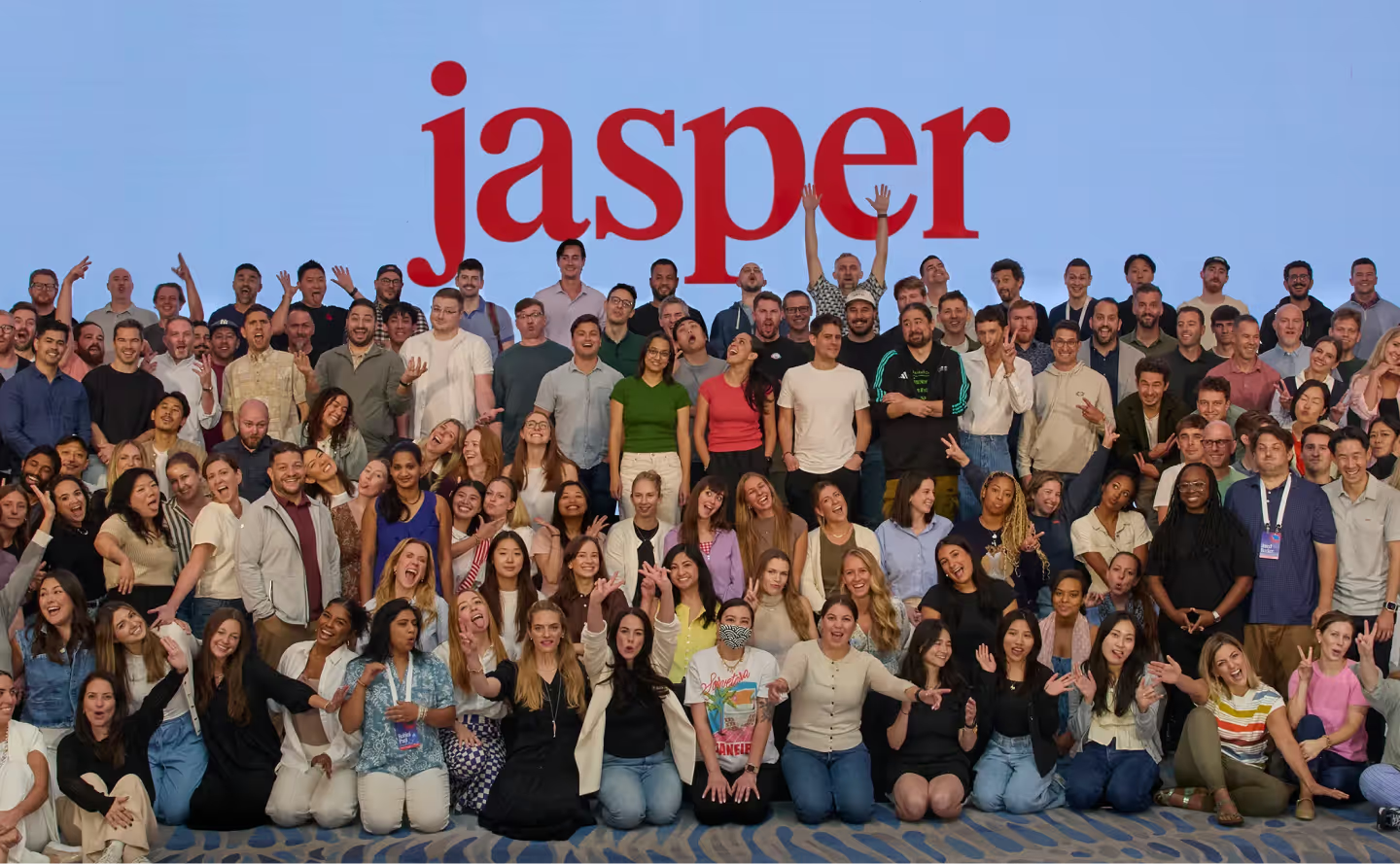
LinkedIn's Steve Kearns on AI, Brand, and the B2B Marketer’s Moment

+
%20-%20Flame.svg)
Replay
June 17, 2025 11:00 AM
EST
LinkedIn's Steve Kearns on AI, Brand, and the B2B Marketer’s Moment
Live from the Jasper Cabana at Cannes Lions 2025, discover how AI and authentic brand building intersect in today's fast-paced B2B landscape.
You should be redirected shortly...
The Webinar Replay recording is coming soon.
Fill out this form to get the recording when it's ready.
Missed the webinar?
Fill out this form to watch the replay.
What we covered
With AI reshaping the marketing playbook at breakneck speed, it’s easy to feel uneasy about the future, wondering how to stand out when technology can level the playing field overnight. But in the midst of all this change, one thing hasn’t shifted: authentic brands and genuine, one-to-one connections still fuel real success.
Live from the Jasper Cabana at Cannes Lions 2025, Steve Kearns, Global Head of Content at LinkedIn Ads, and Esther Chung, Head of Content and Communications at Jasper, unpack the critical intersection of AI and brand in today’s fast-paced B2B landscape.
Discover how the smartest marketers are leveraging AI all while keeping human connection at the heart of their efforts. In just 25 minutes, learn:
- Why brand building is more vital than ever in B2B where everyone has access to the same tools and scale.
- How AI-powered strategies are transforming engagement, personalization, and efficiency for the modern B2B marketer
- How to keep your campaigns innovative and impactful as the expectations of B2B buyers continue to grow.
Access this insightful conversation whenever it fits your schedule and discover how AI can elevate your marketing while keeping your brand strong.
Full Transcript
Welcome and Introductions
Esther Chung: I am Esther Chung, the head of comms and content here at Jasper, and I am so excited to dig into this session about how AI is evolving B2B marketing, how it's changing sales cycles, and how it's really putting brand and trust at the forefront. I'm even more excited to be joined by Steve Kearns, who is our global head of content at LinkedIn. He is also a Jasper customer and a member of our Jasper Customer Advisory Board. Welcome, Steve.
Steve Kearns: Thank you. So excited to be here and great to meet all of you. I love that it's kind of a small, intimate group, so I feel like we can, we can just talk shop.
So look forward to it. Thank you for having me.
Esther Chung: So, Steve, before we get into the session, can you tell me a little bit about your background as well as what you do at LinkedIn?
Steve Kearns: Yeah, absolutely. So I lead content marketing for our advertising business at LinkedIn. So coming up on nine years with LinkedIn, which I cannot believe how the time has flown, I like, look back at pictures from nine years ago and I'm like, oh, I was definitely younger then.
So wonderful place to work, but definitely a busy job, especially during weeks like this at Cannes.
LinkedIn’s Role in B2B Marketing
Steve Kearns: And what my team is responsible for is on behalf of our ads business, we use content as the medium through which we get in front of our customers across the funnel. So, for example, number one, generating awareness that LinkedIn has an ads business. Our awareness is actually surprisingly low for ourselves as an advertising platform. You know, folks think of us as a jobs and skills platform.
So one of the best ways we can do that kind of shift that perception and generate that awareness is through content. You know, we also work on conversion, or I should say consideration. Excuse me, consideration and conversion use cases. So, you know, if we do the right job of getting folks to understand that LinkedIn has an advertising business and, you know, click that awareness, tick that awareness box, then we get into consideration why you should build your brand on LinkedIn as opposed to those on our competitive set.
And then also, you know, equipping our advertisers with the tools they need to actually be successful with advertising on LinkedIn. So content is the medium through which we accomplish all of that. So everything from long form content, short form content, across different, you know, formats and mediums, video, text, et cetera, et cetera, live events. So, you know, we program a lot of stuff in our space.
So this will be a plug to come over to LinkedIn Space for any of our panels. They happen in the afternoons every day. So that all can be found on the Lions app.
So that's one of the things my team's accountable for on the ground here.
Esther Chung: Yes. And definitely join and check out the LinkedIn studio. We went there yesterday and the entire flow that you had, the entire activation you had was amazing.
So I definitely recommend that as well. I'm also really surprised that it has such low awareness.
Steve Kearns: It's, you know, I think we're making progress on it over time, but I think it's, it's, it's kind of a double edged sword because LinkedIn, like capital L LinkedIn brand awareness is high, obviously. You know, I think most folks have a LinkedIn profile. Funny actually my, my partner does not have a LinkedIn profile. He's a lawyer and I'm like the deal breaker. No, actually it was kind of like a selling point. Like our, our first say that like I don't have a LinkedIn profile. I'm like sold. I was like, finally for like eight hours a day I can talk about something that's not LinkedIn.
So I was. But that's a, it's, we have such high brand awareness that I actually think the jobs and skills aspect of LinkedIn tends to overshadow, you know, what we do on the advertising side. So it's kind of been the like crusade of our, my nine years at LinkedIn to embed ourselves in this, you know, advertising community.
So it's something that like, for example, we were just chatting about this outside. We used to be, and I can't believe like I'm saying this as LinkedIn we used to be a challenger brand here on the closet. So when we first came to Cannes, you know, it was like 2015, 2016, it was, you know, the rise of the platforms and you'd see meta, Twitter, Snap, Pinterest. I mean at the time it's called Facebook. Meta didn't even exist.
And the, you know, we were like the little engine that could be, had a little space. We would host some meetings. We had to like, you know, really work to be noticed and seen and what have you.
And then over time we've made this intentional effort and spent a lot of money to, you know, get ourselves on the back of everyone's badge. You know, we have a really big footprint in the Carlton now and you know, that translates or has translated into us being kind of seen as a more major player in this space.
AI’s Impact on the B2B Marketer
Esther Chung: So digging in, I know that LinkedIn has a lot of data on this and this is something at Jasper we talk to talk about a lot about how AI is evolving the marketer's role. Can you tell us a little about what the data says about how AI is evolving the B2B marketer's role?
Steve Kearns: Absolutely. So we do this thing every year called the Workforce Confidence Report, and we have this thing called the LinkedIn economic graph. And basically what that is is it's a digital. I mean, this is like marketing speak, but this is a digital manifestation of the global economy. What that actually means in reality is like, all of you, if you have a LinkedIn profile, every data point that you put into LinkedIn, every time you update your job title, every piece of content you interact with, every time you change your photo, all of that stuff are data points that we can use to look at what is going on in the workforce. Everything from, you know, jobs and skills data, to hiring data, to content engagement and consumption trends, like, all of that good stuff.
So it's super interesting to look at that year over year. You can then cut it by like, if you all do targeting on LinkedIn or advertising on LinkedIn, you can cut it by all of the various targeting facets that we have because they're different ways that you can slice and dice the data. So, you know, what does that tell us? This past year we surveyed CMOs and we took, you know, kind of a pulse, and 90%, over 90% actually said that AI skill building was their top, if not one of their top priorities for their organization. So, you know, I think in with regard to sort of this AI revolution, right. The marketing function is one of the first functions that's actually really starting to be like the vanguards in the organization, if you will, to drive this kind of transformation. So, you know, it's mostly because, you know, AI has become so pervasive in kind of content creative fields. Now, of course, there's like backend stuff that AI does. Every company here is incorporating AI into their workflows, whether it's a SaaS platform, advertising platform, whatever.
But I think the marketer and the marketing leader is really seeing that transformation take hold in their organizations, or at least they're being asked by their C suite to drive that transformation.
Esther Chung: Yeah, we're definitely seeing that in our customers as well. We were just talking to a customer yesterday about this and they were saying they were the first adopters in their organization for AI.
Steve Kearns: So it's how my team was exactly. Yeah. So I do think it makes a lot of sense that marketers are really well positioned to lead time.
Esther Chung: It's really exciting. We also found that over the last six years I'm terrible with numbers so I'm trying, you know, marketers don't ask me to do math or anything, but me too.
Steve Kearns: We're so marketers over the last six years have added AI related skills to their LinkedIn profiles at 7x the rate that they were before. So that's things like, you know, prompt writing, you know, AI literacy, you know, all of the different like filters that you can put on LinkedIn to identify as skills which help recruiters find you, help salespeople find you. If you're, you know, they're looking to sell a solution that has really kind of been up and to the right on, on LinkedIn, which is super fascinating.
Esther Chung: Yeah, that's, that's very fascinating.
Steve Kearns: Yeah, very exciting. At the same time as well, what's been interesting is, and this is kind of a big like proof point or messaging point for us is that we're actually also seeing a rise in human related skills or relationship building skills that people are adding to their profiles. Not quite at the same like you know, up into the right trajectory as the AI skills, which I think makes sense.
But what we're seeing is that organizations are expecting people especially as a lot of, you know, some of that like lower input creative work becomes automated. They are becoming more, you know, they have more time to do things that humans do or that the machine cannot do which is, you know, relationship building, collaborative problem solving, you know, all those things that like you can't quite put a point on that, you know, it'd be very hard to train a machine learning model on right now. At least, you know, I think there would be, it's been really interesting to watch that rise to the top as well because it's not something you would necessarily assume would be, you know, the, let's say second or third most pervasive trend.
Esther Chung: Right. And that's really interesting, the correlation between the two. Also part of that around like around the authenticity in humans. Why do you think that brand is going to be so much more important for B2B?
The Rising Importance of Brand and Trust
Esther Chung: I just saw this interesting Stan Gartner, that by 2026 or so 60% of CMOs are going to be really leaning in on UGC content.
Steve Kearns: Yeah. And LinkedIn is doing that at the Carlton.
Esther Chung: Yeah, exactly, yeah. So yeah, if you want to stop by the Carlton, come find me. You can name drop me and I'll let you cut the line because the line is, the line is big.
So we, we can get you sorted but we're doing self recorded videos Ugc you know, encouraging folks to post, folks to post to LinkedIn actually for anyone in this room, we're also offering thousand dollars ad credits to help you boost your post on LinkedIn. So you know, the whole idea is you actually get a little bit of like a. And this goes into the whole, you know, top track around brand.
But part of the thought around the ad credits too was I can't believe they. It's such a pain in the ass to set them up. But actually Elaine, you might have been part of some of those email threads on ad credits.
But the, you know, part of that is kind of like the dopamine hit that people will get once they see the engagement, they see the interaction and connection that they get on the platform. You know, we hope there's kind of a snowball effect with that. So, you know, I think that kind of dovetails nicely into the question around brand.
Steve Kearns: So you know, something that we are big proponents of at LinkedIn is, you know, we want to own the B2B marketing space. We are the world's largest professional network. We have the world's largest professional data set. You know, we are purpose built for B2B marketers because of our targeting capabilities, because of, you know, really every the professional context within which audiences come to LinkedIn.
So that just becomes a really rich environment for brands looking to reach buying groups, you know, B2B professionals, what have you. Now within that context, I feel like there's this kind of pervasive thoughts that, you know, your products are going to be the thing that differentiate you, that your price is going to be the thing that differentiates you because people believe that B2B is this like somehow hyper rational decision. And for years we've actually done a lot of research that demonstrates that B2B purchasing decisions are actually as emotional, if not more emotional than consumer decisions because the, you know, burden of proof is higher, the risk is higher. Hey, I'm going to bring on like an ERP solution that is going to cost $5 million a year in an enterprise organization. If that's screwed up, I get fired. So, you know, that is something that a lot of B2B marketing does not take into account. Yes, the emotional drivers of what actually gets someone to, number one, you know, agree within a buying committee and then number two, get to a place where you can actually say yes and sign the check.
So that is where when we think about like what is the value of brand? Yes, brand can help create those emotional connections with your audience that allow them to. And it feels so like snake oils, these salesmen, to say this, but, like, allow them to behave irrationally. You know, so much of like, I think maybe in another life, a lot of marketers would be psychologists or like anthropologists or something, because we're just curious about how the world works and how people make decisions and what, what motivates people, what makes people think and do and feel.
So that's something that we are. I think that's something that brand is incredibly, you know, valuable at accomplishing because it's the, you know, what makes, what makes someone choose a Coke over a Pepsi? That's probably a bad one because that's a very, like two very strong camps of thought there. Like, I believe that Diet Coke tastes different than Diet Pepsi. But, um, the, you know, it's. It's the fact that like, I grew up watching the Olympics and you know, you see the Coca Cola Polar Bear commercials and every country you travel to, you know, you see a billboard in a different language with that same typeface and that same color. And, you know, that's the kind of stuff that, you know, starts to hack the, you know, subconscious. I don't know, subconscious or unconscious. I think subconscious. Subconscious mind. You know, it's like five hours of sleep and like, you know, seven drinks a night will get you to conscious. Um, the. Yeah, as. As one doesn't can, but yeah, it's. I think it kind of hacks the, the subconscious mind to say, well, oh, this is something that I'm didn't realize. You know, this is something that I will consider more or that I'm more likely to choose. Right.
So that's where brand can be really effective. And that's something that I think as marketers, we have to continue to educate the organization on because brand is expensive.
Esther Chung: And you mean.
Steve Kearns: I look at like, I think the back of the badges for us are a perfect example of this. You know, I was walking down the closet today and the actually back of the badges and the LinkedIn studio that we have, so previously we had spent maybe like, you know, we spent a couple million dollars a year to show up at Cannes, but we did not really have any sort of like, out of home presence. So no one really knew that we were here spending all of this money.
And then this year, actually last year and this year we made the decision to say, hey, why don't we actually shift some of our investment to ensuring that we are highly, highly visible? Because that also helps solve for that awareness challenge. You know, I would be surprised if after a few years, at least if you isolate to the CAN audience or folks who attend can, if our awareness would be low because every single person walking down the closet has a walking LinkedIn advertisement attached to them and a QR code that goes to our microsite. A, you know, a landing page where folks can, you know, sign up for, sign up for activation, experience the brand and then you know, they get worked into an email drip and we retarget them.
So like that is, it's brand, it's a brand investment. But then you apply kind of a performance marketing lens to it and hopefully you start to, to kind of make some progress against some of the things you're trying to make progress against.
Esther Chung: And half the time I had my badge backwards. So yeah, like I'm also badges advertising everyone else.
Steve Kearns: Yeah. So I mean even then you get, you get your eyes on it actually related to that. So I know like as a B2B marker and I've also been beating marker most my career.
Esther Chung: Yeah.
Steve Kearns: Was always the headline is sales cycles are longer than ever.
Esther Chung: Right.
Steve Kearns: More decisions, more stakeholders. And I think even with AI, it's the stakes are way higher.
Esther Chung: Yeah, right. So can you talk a little about what actually builds that trust?
Steve Kearns: Yeah, so I think the, what builds the trust is or are, I should say human relationships. So you know, if you look at like the utility of can, for example, I think, I think this can is a perfect example of this. Anyone who has not been to CAN before, you know, we have a lot of marketing leaders who will come into the business who come from different, you know, sector.
So they haven't worked in advertising, you know, marketing to marketers before. You know, they'll see the line items for can and they'll see the, you know, they're like, why is this so expensive? Why do we do this? I cannot justify this.
But if I think about the every relationship that I've done, not every relationship, a lot of relationships I've built in this industry that have actually resulted in business for LinkedIn or you know, business for a vendor we work with or what have you have been cultivated in spaces like this. So what does that tell you, especially in a world where I think we've now over indexed on digital folks are looking for human connection. You know, there is a, I mean there's, there's data, like anthropological data on this, you know, out the, you know, out the rear is that we are kind of in this like isolation crisis and people are looking for connection and connection is what's going to drive people forward to actually, you know, want to be somewhere I want to do something.
So I think that's where the. And if you think about, like buying group dynamics, right. Say there's like 20 different people in a buying group. If you all work in large enterprises, I'm sure you have experienced this. You know, there's not a sole decision maker. You have about 20 different people who are talking in circles who, you know, have different agendas and different, you know, sit in different buying centers and, you know, with different budgets and different perspectives.
And they all at some point have to agree so. Or at least agree enough so that they will stop putting up a fight. So you know, what actually gets them all to agree? It's like these. It's these relational dynamics that, that help people make that decision.
Navigating Noise and Building Connection
Steve Kearns: So that's where I think you can kind of play into the, you know, if you think about AI, you know, bring it back to the topic of AI. If you think about AI's ability to create things like content at scale, to personalize at scale, and then you allow the folks on your team to actually go out into the field, whatever into the field means. Maybe that means, you know, they're posting more, you know, UGC video of your social team and you're interacting with people online as opposed to just creating so much content in like a dark back room. I think there's, there's components of this that tap into. If you get people out connecting with other people, whether that's online, whether that's in person, that's going to be the thing that's the differentiator of driving forward these. These decisions.
Esther Chung: Yeah, that makes sense. And honestly, this is my first time at Cannes and walking through everything, it does feel like probably what a buyer feels like digitally because it's so much noise.
Steve Kearns: Yeah.
Esther Chung: And there's just so much incredible stuff that's happening and like, being able to stand out.
Steve Kearns: Right.
Esther Chung: How does LinkedIn think about that?
Steve Kearns: Yeah, so we think about it. It's this, like, honestly, it's an internal struggle because you have the people who think in dollars and cents and in, you know, black and white and in spreadsheets. And then you have the, like the showman. You can guess which camp I fall into, but I'm like, you know, every year it's like, why do we need this? Why do we do this?
And then people come on site and they're like, wow, I get it. Because there is a. And this dovetails back into brand. There's this idea of, like, especially in a creative field, like marketing and advertising, you need to have some Element of swagger it is.
And I actually think that's true for a lot of different brands and a lot of different sectors because people want to work with someone who is not only like trusted and credible, but also cool and interesting. And, you know, if you think about how people interact with brands and what have you, sometimes the people can align, you know, the brands they choose to work with or the brands they choose to buy or whatever, say a lot about their identity and their values. And that's where it's like, as you start to create what your brand looks like, as you start to create what you want to be known for, you know, that's where like Persona work comes in, for example.
And you say, okay, who is my target audience? What do they care about in the marketing and advertising context? Our audience cares, you know, in the context of can they care about speaking opportunities, opportunities to connect with other people? You know, we try to become a digital or a physical manifestation, I should say, of the digital work that goes on on LinkedIn, I. E. You know, A center of connection and a place where people go to give and get help.
And now, like, that's not to necessarily say that if we were to go to a talent event or, I mean, our brand team would disagree with me on this, but, like. Right. You know, you could make an argument that a footprint reaching a different target audience would look different. The. I mean, I think it happens to a certain extent. Like our. We have a big event called Talent Connect. If you look at Talent Connect, it might be just as expensive as this, but the way that that manifests is very, very different. You know, there's not a bar at Talent Connect that opens up at 11 o' clock in the morning that serves Rose. There is one here.
So it's like, you know, there's a lot about context, what your audience expects.
Esther Chung: Yes.
Steve Kearns: That becomes hard to actually differ. You know, it becomes hard to sell in when you have a brand that's trying to achieve consistency across, you know, different places and spaces. So there's a little bit of tension there.
But we have over the years, I think, been really successful at creating a space that feels cool, that people want to talk about, people want to go to, and hopefully that starts to translate into things that we care about from a commercial perspective. We use this metric called the Core 4. It's like daily active users, basically what Microsoft, our parent company, keeps us accountable to, to say, you know, did you meet your goals or not?
So we, we're trying to actually do a little bit more this year. To get folks into that, like away from awareness and more into consideration and conversion. So, you know, getting people into the product with video, like, huge area of opportunity for us because, you know, we kind of saw that TikTok was starting to eat our lunch a little bit in terms of professional video. We're like, look, this is.
And you know, of course that's huge ads, but ad budget sitting in the video space. So, you know, we have tried to start to, now that we've established that awareness, at least here at can deepen our relationship with people to actually get them in product, to actually get them understanding what it is that we can offer to them. So that was a very long answer.
Esther Chung: No, no, I think that makes sense. And it really hits on. You were talking about consistent consistency.
Steve Kearns: Consistency.
Esther Chung: Was that such a hard word to pronounce?
Steve Kearns: Consistency?
Esther Chung: And like, my last final question is a little bit fun. Obviously, Jasper, we excel at consistency, driving brand voice across different audience segments. But the one thing you said in the beginning was AI still hasn't been able to figure out and tap into that what makes humans feel special. If you were an AI model, this is a tough question and it had to be trained on your instincts or your leadership style. What would be your killer use case?
Future of AI and Human Touch in Marketing
Steve Kearns: Yeah, well, what's interesting about AI in general, at least my limited understanding of it as a marketer, is that you think about how like human beings learn things, right? Like, you think about learning language, you think about learning like social norms, what have you. Like, all of that's relational.
So it's like, okay, the best way to learn a language is to immerse yourself in the language. Because all of a sudden you can't communicate. You have to figure out how you do that. You watch other people do it, and then all of a sudden you learn. Same thing goes in like, you know, norms in business or ways to do things in marketing. What's effective, what's not?
So I think there is in, you know, if I had my wish, it would be. Actually, I don't know if I necessarily wish for this because then I'm out of a job. But the, you know, the idea that the tools start to understand the emotional drivers of what actually gets someone to make that decision. Now, right now, that's sort of the human advantage that people can bring to the table, which is like, hey, you have this strategic lens that you can apply to what is created in order to actually, you know, move your work forward and make it effective. I think maybe there's a world in the future where there's some kind of data synthesis that goes on of like hey we see people and I think this goes into the agentic future that we're starting to look at is hey there's something here that can actually help me understand why people make the decisions that they do.
And the cool thing about what this might actually enable us to do is it's unbacked by data, not necessarily even like anecdotal. So you know, you can have like a deep seated belief that's only, you know, kind of like a bias but you hopefully would have the tools be able to look at. Hey this is something that we see people doing a behavioral trend that you can tap into as a marketer. Here's the suggestion that you know that we, that we want to bring to the table.
Esther Chung: Yeah, I love that actually when I was thinking about this too I also kind of had a similar thinking around like the kind of data that would be a little bit external third party as well as like.
Steve Kearns: I totally agree.
Esther Chung: The Agentix platform.
Steve Kearns: Yeah.
Esther Chung: Jaspering agent.
Steve Kearns: I'm excited about it actually like being able to automate decision making I think that is.
Esther Chung: And workflows and really customizing it.
Steve Kearns: Yeah.
Esther Chung: Your enterprise totally.
Steve Kearns: Yeah. Is something that I'm also and I do think there will be an opportunity like you know people ask me this question all the time and they're like dmg, do you think AI is going to like replace all marketing jobs?
Esther Chung: I'm like I actually don't think so.
Steve Kearns: I think it's going to make the marketer a lot more efficient now of course like I'd be lying if I said there wasn't anxiety around the types of like workforce disruption and what have you that we're starting to see as a result of just like a really big transformational shift. Like you know this is as big as the industrial revolution and no one on earth has lived through something like that. You know this is bigger than the Internet.
Esther Chung: Yeah.
Steve Kearns: Because it changes the way that people do their. I mean I guess the Internet also changed the way people do their work but this is, I think this is even more, more interesting.
Esther Chung: Moving fast.
Steve Kearns: Yeah. So it's going to be up to us to continue to upskill, educate ourselves, you know, become at the forefront of how you leverage these technologies to stay current and relevant. And it's that relational component too that like a machine's never going to be able to come to can and close a deal. You know that is something that I think we will get to lean more into as time goes on which is exciting.
Esther Chung: Yeah, definitely.
Closing Remarks and Thank You
Esther Chung: And on that note, thank you so much, Steve.
Steve Kearns: Thanks for having me.
Esther Chung: If you want to thank him. Thank you for sharing all your insights. And if you want to stick around, we are doing a custom fragrance. Just part of the personalization aspect, of course, that you know and, and you can design a fragrance that smells like you, that you want yourself to smell like.
And then also there's something I'm thinking, like, smells like you. I don't know if you would want to fragrance better than I smell in Canada, like at 5pm but also you can grab some drinks and some food. But stick around and hang out with us. Thank you.
Steve Kearns: Thanks for having me.

.png)
More webinars & replays
September 10, 2026
September 10, 2026 12:00 PM
EST
From Insight to Action: Why Marketers Need Agents to Win AI Search
Jasper CMO Tom Newton sits down with Raakhi Agrawal and Robert Derow of BCG X to break down why you need agents—not just insight—to win AI search.
Hosted by



Raakhi Agrawal
Managing Director and Partner, BCG X

Robert Derow
Managing Director & Partner, BCG X
August 13, 2026
August 13, 2026 12:00 PM
EST
Meet the GEO Agent: From Insight to Action, Automatically
GEO isn't one task. It's hundreds of them, repeated continuously as AI answers shift and competitors move—and a citation you win today is no guarantee you'll hold it next week.
Hosted by


Kurt Lambert
Senior GEO Strategy Manager, Jasper
Megan Johnson
Director, Product Strategy and Operations, Jasper
April 30, 2026
April 30, 2026 12:00 PM
EST
AI Tools Don't Scale, Systems Do: Bonterra’s Approach to Content Orchestration
Most marketing teams have solved content generation. The real challenge is orchestration: building repeatable AI systems that scale output, cut cycle times, and keep quality consistently on-brand.
Hosted by


Neil Grasso
Customer Advocacy Marketing Manager, Bonterra


Steve Kearns
Sr. Director, Customer Evangelism & Community-Led Growth, Jasper
Put AI agents to work, on your terms
Explore how Jasper agents help teams turn strategy into execution across every channel, market, and audience.




- © 2026 Jasper AI, INC.
- Privacy Policy
- Terms of Service
- Legal Center