






.png)
Megan Dubin
January 7, 2026
The Future of B2C Search Isn’t Keywords: Preparing for AI-Driven Discovery in 2026
Discover how B2C brands can win AI search in 2026 with AEO/GEO, trust signals, and structured content for Google, ChatGPT, Perplexity, and Amazon.

Keywords have long shaped how brands capture search visibility. But in the AI era, search and discovery are becoming far more dynamic. Consumers are no longer querying generic keyword phrases; they’re asking for direct answers and recommendations tailored to their needs and intent.
According to McKinsey, half of consumers already use AI in their online searches, and an estimated $750B in consumer spend will run through AI-powered search by 2028. To remain visible and connected to their audiences, brands need AI-driven search strategies rooted in AEO and GEO and built to adapt as new AI capabilities emerge.
B2C search in an AI era
AI has changed what it means to “rank.” Keywords are still relevant for tying content to the right topics and search queries, but on their own they won’t maintain visibility in an AI search discovery landscape.
For B2C brands, matching intent and building trust are paramount. Search visibility hinges on signals that prove a brand is credible, accurate, and consistent across channels. AI systems look for patterns and cues that help them establish your brand is trustworthy to share with users. Designing content to align with both customer needs and AI search signals is essential.
Ranking signals that matter most today:
- Real-world trust cues: Verified reviews tied to actual products, clear sourcing or ingredient details, and visible proof behind any claims
- Structured clarity: Schema that fully describes your products (i.e. attributes, uses, instructions) so AI can understand and reuse the information
- Message alignment everywhere: Product names, specs, descriptions, and benefits that match across your site, retail partners, and social channels
- Signals that you’re safe to cite: Clear authorship, evidence, and references that show your brand isn’t guessing or inflating claims
- Authentic consumer signals: Social proof and engagement patterns that reflect real customer experiences, not manufactured hype
When trust signals are strong, AI systems have the information they need to surface your content confidently, and users have what they need to believe it.
How B2C marketers can optimize for AI discovery
Winning visibility in an AI-driven search era requires content that’s structured, consistent as well as aligned with real consumer intent. The following framework can help your team create content AI systems can confidently find and share while also giving customers clear information that supports their decision-making.
Map consumer intent
AI engines look for content that solves the exact questions people bring to search. When you map real consumer questions and shape content around them, your content becomes easier for AI systems to recognize as relevant and worth surfacing.
How to do it:
- Pull conversational data from consumer channels (ex: Reddit, Quora, social media comments) to identify phrases customers use.
- Categorize findings into informational, transactional, and comparative intent, then flag patterns that appear most often.
- Translate top questions into structured content like FAQs or buying guides
- Write answers in clear, conversational language so generative engines can reuse them easily.
Create a unified product knowledge layer
AI evaluates whether your product information is complete and consistent across search channels. A unified knowledge layer gives you a single factual backbone that informs all marketing, retail, and educational content.
How to do it:
- Build a centralized reference document with all important product information and approved marketing messaging for each.
- Apply this reference across consumer facing touchpoints (ex: PDPs, retail listings, influencer briefs, affiliate content, or press kits).
- Use structured sections such as “Ingredients,” “How It Works,” or “Who It Is For?” to make the information uniform and machine-readable.
- Update the knowledge layer on a set cadence and any time information changes.
Build intentional brand trust signals
With trust at the top of the priority list for human users and AI systems, it’s critical to make verification effortless. Claims, sources, and real-world outcomes must all be easy for AI to surface across all content and channels.
How to do it:
- Strengthen content with evidence-based claims, transparent sourcing, customer reviews, expert endorsements, certifications, and before/after information.
- Highlight verified reviews and ensure metadata fields are complete so engines can understand them easily.
- Include authorship details and clear citations in educational and thought leadership content so AI can verify your information.
- Pair every claim with visible proof such as test results, user testimonials, photos, or third-party validation.
Format for multi-engine visibility
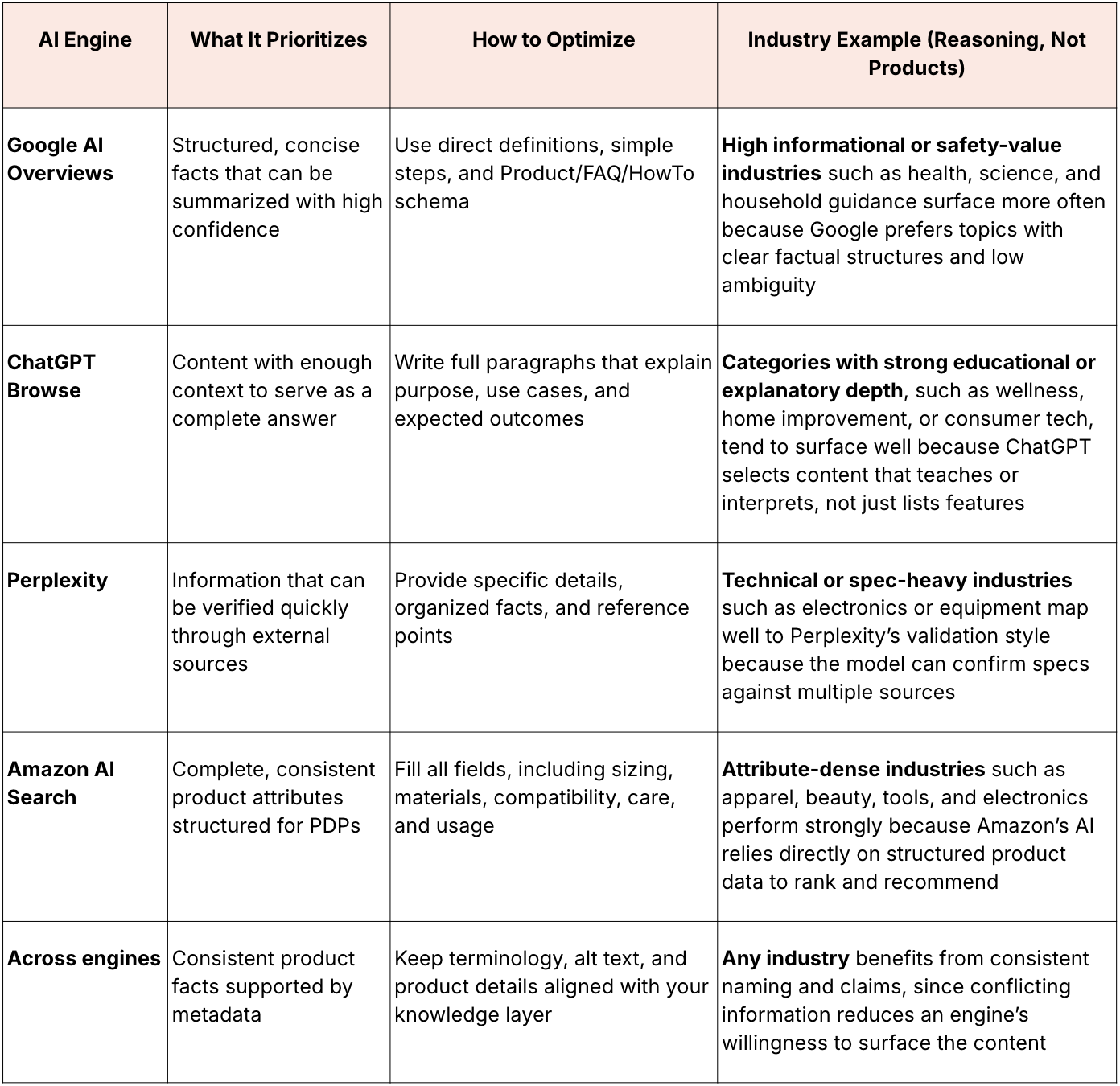
AI search platforms surface information differently, so content must be structured in ways that match each engine’s preferred format. Top engines like Google Overviews, ChatGPT, Perplexity, and Amazon AI weigh factors in their own ways, and marketers must be in tune with each one to keep content holistically visible.
How to do it:
- Create content to match the level of detail different engines prefer, from concise summaries to full contextual explanations.
- Account for topical factors; each engine surfaces information differently based on complexity, risk, or informational depth.
- Keep terminology, metadata, and product facts consistent across channels so AI systems don’t encounter conflicting signals.
Measure AI presence
AI visibility improves most effectively when teams treat it as an ongoing opportunity to grow. Tracking the platforms and search topics where your brand is earning the most traction—and where it needs to improve—ensures your strategy stays fresh over time, especially as platforms continue to evolve.
How to do it:
- Use monitoring tools to comprehensively track your brand’s visibility across top search platforms
- Use share of voice tools and recurring manual queries to benchmark visibility for specific, priority intents and product categories.
- Identify which content formats consistently perform well and expand these formats across other categories.
- Refresh your content periodically to reflect new market demands and AI search behavior patterns
Building adaptive content ecosystems in the AI era
AI search discovery continues to evolve, and so do the inputs that shape visibility. The top factors outlined in this guide—intent alignment, clear product information, reliable trust signals, and multi-engine readiness—depend on content ecosystems built for continuous adaptation.
A connected, scalable content pipeline for B2C marketers should be supported by:
- AI agents and automation that execute core content workflows and keep assets aligned across the ecosystem
- Marketing AI tools that support scalable content creation and maintain a strong brand voice across assets
- Centralized performance reporting to give a single, real-time view of how content is performing on topic categories and search surfaces
- Flexibility to improve as search and discovery evolve so content can adapt without breaking the system
What this ultimately creates is a system that can keep pace with how AI refines discovery. Instead of chasing every new platform change, teams can operate from a foundation that absorbs new requirements and adjusts without starting over. As AI models introduce new surfaces, formats, and expectations, a connected ecosystem gives brands the stability to adapt and stay visible no matter where consumers begin their search.
Learn more about AI search optimization for B2C marketers.

More of the latest & greatest
.png)
How Agencies Can Build AI Search Visibility Reports for Clients
A practical framework for building AI search reports that show clients where their brands appear, how visibility is changing, and where to act next.
September 30, 2026
|
Megan Dubin

How to Measure AI Brand Sentiment Across AI Search Models
A practical framework for measuring AI brand sentiment across models like ChatGPT, Perplexity, Claude, and Gemini and consistently tracking sentiment over time.
September 28, 2026
|
Esther Chung

AI Search Attribution: What GA4 Can & Can't Track
AI search doesn’t always pass a clean referral signal. Here’s how to use GA4 alongside impressions and citation share to get a meaningful view of performance.
September 25, 2026
|
Kurt Lambert