






.png)
Jasper Marketing
February 18, 2026
AI Maturity Is the Strongest Predictor of Impact in 2026
The most advanced marketing teams have cracked the code on AI scalability, governance, and ROI measurement.
.png)
At the beginning of 2025, AI in marketing was still relatively new. Less than two-thirds of marketers used AI, and some were hesitant or skeptical. Those that did faced challenges related to adoption like lack of internal expertise and insufficient budget.
Fast-forward to today and AI is the standard. More than 9 in 10 marketers use AI and plan to increase their AI budgets in 2026. AI adoption alone is no longer a differentiator. The competitive advantage has shifted to solving a new challenge: successful execution at scale.
Marketers’ #1 goal for AI in 2026 is to scale content production and operations, but with increased content volume and velocity come new challenges. As they enter the operational era of AI, marketers are struggling to resolve blockers from legal, compliance, and brand reviews, connect AI to measurable business outcomes, and implement more advanced AI use cases at scale.
Jasper’s State of AI in Marketing 2026 report shows that organizations self-reporting as “advanced” or “very advanced” in AI maturity have already figured out some of these hurdles. High-maturity organizations have established repeatable best practices across content production, quality governance, ROI measurement, and clear ownership for outcomes—and can offer a path forward for their peers looking to do the same.
Here’s a closer look at six ways high-maturity organizations show the way forward for operationalizing and scaling AI.
1. Content as a system
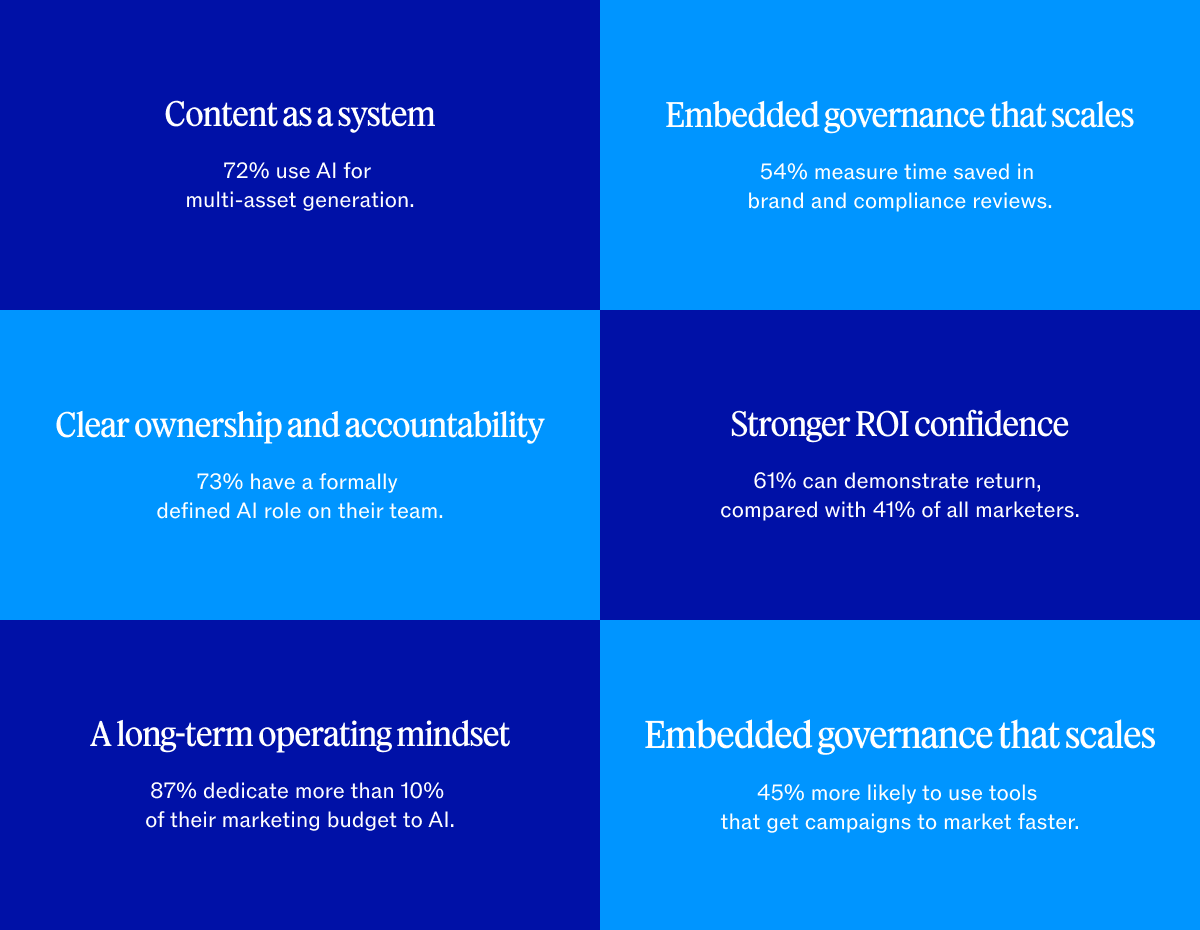
Very advanced organizations use AI as part of a repeatable content system, treating it as marketing infrastructure rather than a standalone tool. 72% use AI for multi-asset campaign generation, compared to 35% of beginners.

High-maturity teams are also less likely to rank idea generation as their top use case. Instead, they use AI to support end-to-end production workflows that span content planning, creation, adaptation, and activation. In these organizations, AI helps work move efficiently through the content pipeline while staying aligned with brand standards.
2. Embedded governance that scales
For high-maturity organizations, governance is embedded directly into marketing workflows. Advanced teams are nearly 4x more likely to have a role defining AI strategy, governance, and policies than beginners. They’re also nearly 5x more likely to have a role building AI systems or content pipelines.

This ethos carries over into how they measure the return on their AI investments. Over half (54%) see “time saved in brand and compliance reviews” as a crucial ROI metric.
3. Clear ownership and accountability
As AI scales across marketing operations and workflows, ownership is crucial. AI-mature organizations define responsibility for AI outcomes explicitly, and 73% of advanced organizations report having a formally defined AI role that creates clarity across strategy, operations, and execution.

Without this structure, responsibility can diffuse quickly. Teams end up with widespread AI usage but no clear ownership for performance, risk, or results. High-maturity organizations avoid this trap by assigning accountability early, ensuring AI initiatives are actively steered and measured rather than left to evolve in isolation.
4. Stronger ROI confidence
Very advanced organizations report significantly greater confidence in their ability to prove ROI from AI investments. Sixty-one percent say they’re able to demonstrate return, compared to just 41% of the total population.

When ROI is measured, these organizations rely on more sophisticated metrics tied to operational and performance outcomes. They are more likely to track time saved in brand review, campaign lift, and other business-impact indicators vs. focusing primarily on hours saved alone.
.png)
This demonstrates a more mature understanding of AI’s value that connects execution efficiency to measurable business outcomes.
5. A long-term operating mindset
Financial investment patterns reinforce AI maturity. 82% of high-maturity organizations dedicate more than 10% of their marketing budget to AI, compared to 37% of beginning organizations. 1 in 3 expect increases of 20-50% or more.

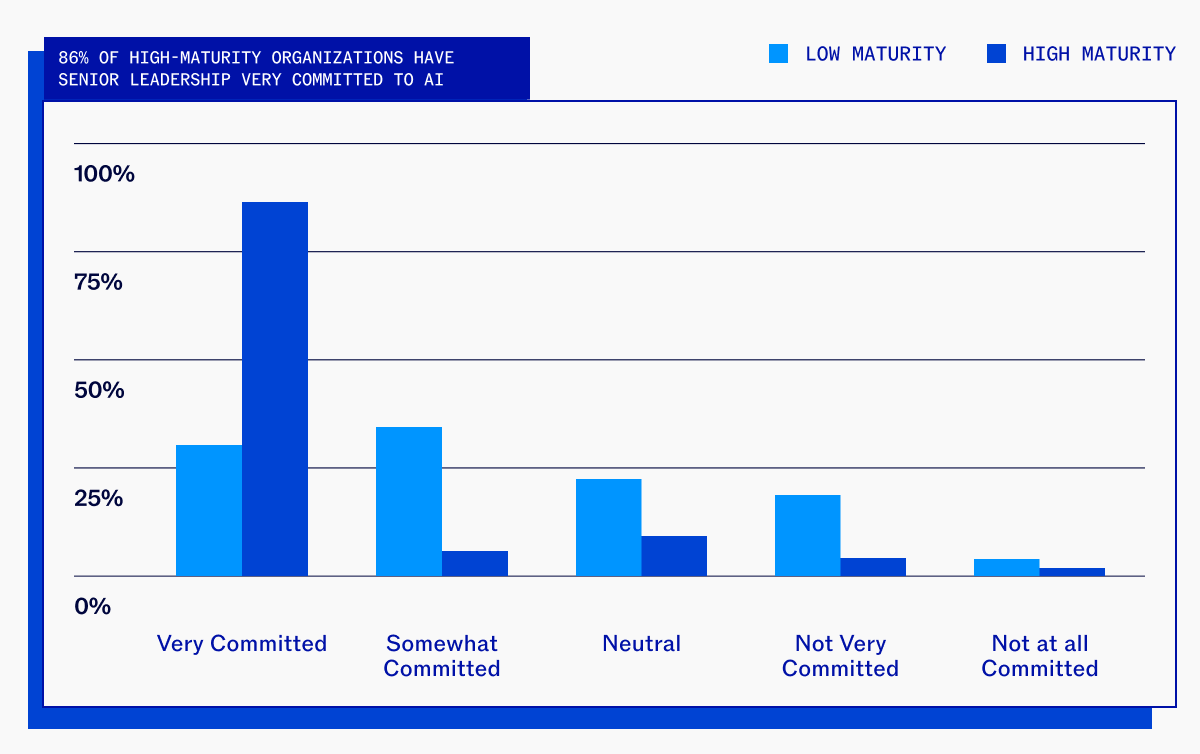
Leadership commitment follows the same pattern: 86% of very advanced organizations report very committed senior leadership, compared with just 32% of beginners. This points to AI being viewed as a core long-term operating capability vs. a discretionary or experimental spend.
6. Marketing-specific tools and workflows
High-maturity organizations are 45% more likely to use tools and workflows designed for marketing (as opposed to generic tools). In turn, domain-specific AI tools align more closely with the practical realities of marketing work, enabling faster execution and clearer ROI measurement.
Organizations that use marketing-specific tools are 1.5x more likely to bring their campaigns to market in weeks or days than those relying on generic AI tools. They’re also more likely to measure shortened campaign launch cycles, cited by 49% of domain-specific tool users vs. 34% of those using generic tools.
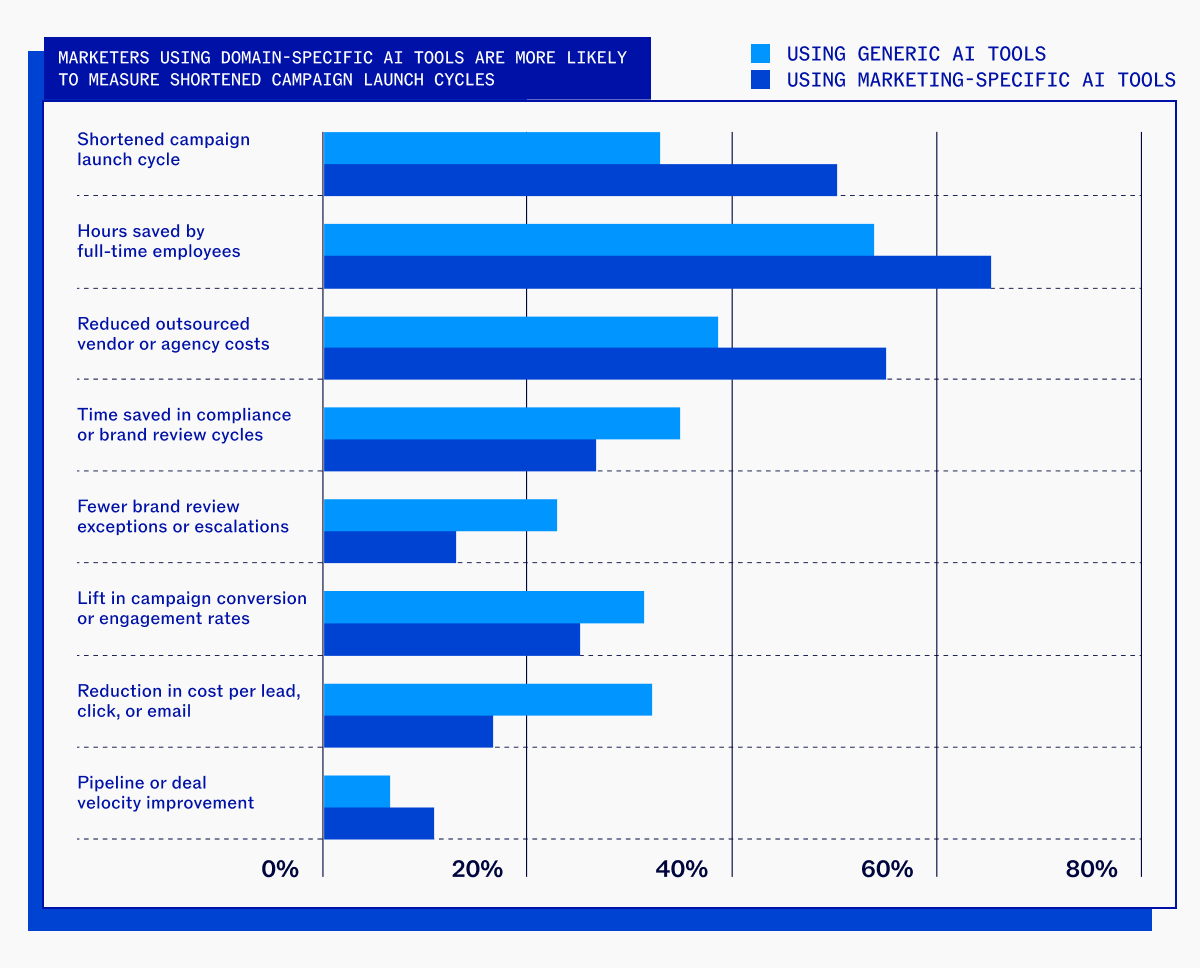
This shows a broader pattern: Tools built specifically for marketing workflows make it easier to operationalize AI at scale and embed governance without slowing production.
Looking ahead: A new meaning for AI maturity
AI maturity is no longer defined by how early an organization adopted new tools or how widely AI is used across teams. In 2026, it reflects how intentionally AI is designed into marketing operations, from content production and AI governance to ROI measurement and performance accountability across teams.
High-maturity organizations view AI as part of their operational discipline and treat it as infrastructure, and by doing so they achieve a clearer connection between AI investments and business outcomes.
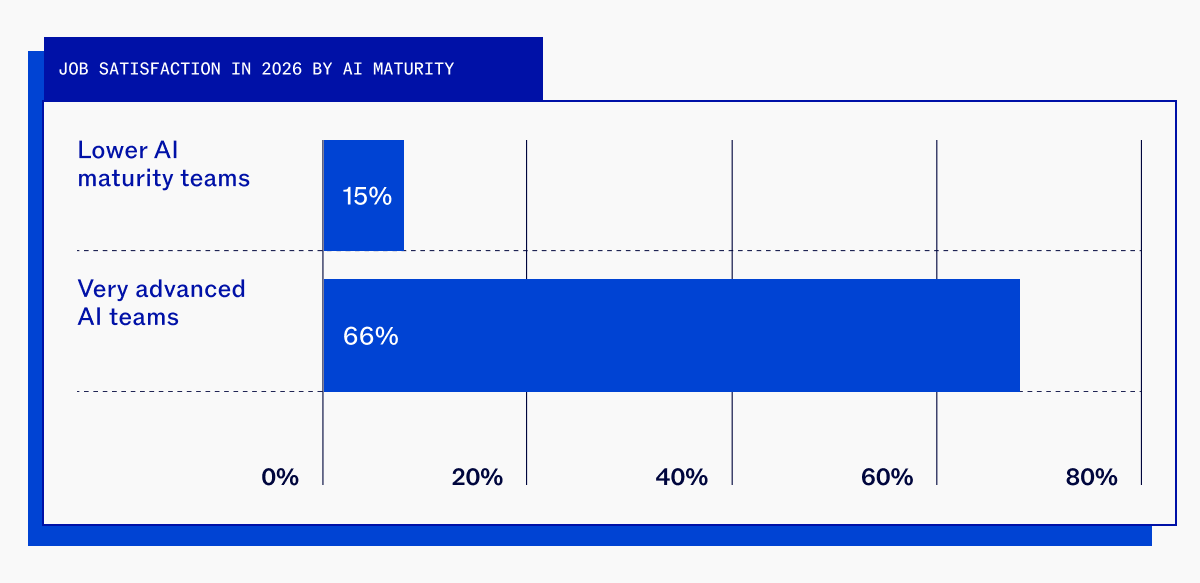
At the same time, their teams become more productive and happier in their roles—66% of high-maturity organizations report increased job satisfaction from their roles compared to just 15% in beginner organizations. When teams experience AI as an embedded part of the way they work with clear guidelines, they embrace it more readily and use it with confidence.
Download the full State of AI in Marketing 2026 report for more on how the most advanced organizations show the way forward.

More of the latest & greatest
.png)
How Agencies Can Build AI Search Visibility Reports for Clients
A practical framework for building AI search reports that show clients where their brands appear, how visibility is changing, and where to act next.
September 30, 2026
|
Megan Dubin

How to Measure AI Brand Sentiment Across AI Search Models
A practical framework for measuring AI brand sentiment across models like ChatGPT, Perplexity, Claude, and Gemini and consistently tracking sentiment over time.
September 28, 2026
|
Esther Chung

AI Search Attribution: What GA4 Can & Can't Track
AI search doesn’t always pass a clean referral signal. Here’s how to use GA4 alongside impressions and citation share to get a meaningful view of performance.
September 25, 2026
|
Kurt Lambert