






.png)
Megan Dubin
September 26, 2025
The Most Common AEO and GEO Questions, Answered
An FAQ about adapting your SEO strategy for AI. Get answers to your top questions about answer engine optimization (AEO) and generative engine optimization (GEO).

With the rise of AI-powered tools, traditional SEO is no longer enough. New concepts like answer engine optimization (AEO) and generative engine optimization (GEO) are now essential for marketers who want to stay ahead of competitors in search. This shift brings up many questions about strategy, measurement, and the future of search itself.
If you're wondering how to adapt, you're not alone. There were over 150 audience questions on a recent webinar about search, discovery, and strategy in the AI era.
This FAQ guide explores some of the most pressing questions about the new era of AI-driven search. We'll cover everything from content strategies to industry nuances and how to measure success.
The impact of AI on search
1. Where does AI search extract data from?
AI search engines extract data from a vast range of online sources. While they rely on the same internet that traditional search engines crawl, they show a preference for certain types of content and platforms.
Analysis shows that AI Overviews and LLMs frequently cite sources like:
- User-generated content platforms: Reddit and Quora are two of the most cited sources across nearly every industry.
- Authoritative reference sites: Wikipedia is a major source for AI training data and is frequently linked in AI summaries.
- Video content: YouTube is a top source for both standard search results and AI-generated answers.
- Credible publications and blogs: Content that is evidence-backed, transparent with its authorship, and well-structured is more likely to be used.
2. Which traditional SEO tactics are becoming less relevant, and which are gaining importance in the AI era?
While the fundamentals of good SEO remain crucial, the emphasis is shifting.
Gaining importance:
- Topical authority: Demonstrating comprehensive expertise on a subject is more important than ever. Instead of focusing on single keywords, create a connected body of work around a core theme.
- Structured data & schema: Using clear headings (H2s, H3s), lists, tables, and technical markup (like FAQPage or HowTo schema) helps AI engines parse and extract your content.
- Content freshness: Regularly updating content with the latest information is critical, as AI tools aim to provide the most current answers.
- Brand mentions & PR: Unlinked brand mentions on trusted third-party sites, forums, and social media carry more weight, as they signal credibility to AI models. Digital PR and guest posting are becoming increasingly relevant.
- Clear, direct writing: Writing content that explicitly answers a question and can be quoted out of context is now a key tactic. This is a shift from simply optimizing for keywords.
Becoming less relevant:
- Focusing solely on #1 rankings: Since AI Overviews can answer a query directly, being the top blue link no longer guarantees a click. Traffic can decline even if visibility and impressions increase.
- Keyword stuffing: While keywords still matter, unnaturally forcing them into content is less effective. Google's E-E-A-T fundamentals advise against creating "search engine-first content," and the same idea applies for AI search. Conversational language that mirrors how users ask questions is more valuable.
3. How is AI search changing traffic patterns and attribution models?
AI search is causing a significant shift in user behavior and making attribution more complex.
Traffic patterns: Research shows that when an AI Overview appears in Google results, users are less likely to click on a traditional organic link. This can lead to a decline in website clicks even if your impressions are high. However, other studies indicate that traffic from LLMs like ChatGPT is highly qualified, with visitors being 4.4 times more likely to convert than those from traditional search.
Attribution challenges: The customer journey is becoming less linear and harder to track. A significant portion of a buyer's research may now happen within a single chat window, where they learn about your brand, competitors, and pricing. When they finally click through to your site, they are already highly informed, but you lose visibility into the preceding touchpoints. This makes it difficult to attribute conversions to specific marketing efforts like PR or social media, which may have influenced the AI's response.
Content strategy for AEO and GEO
1. What are the first steps businesses should take to improve their AEO and GEO performance?
- Start with an audit: Use a tool to understand your current visibility in AI search. Identify the prompts and topics relevant to your brand and see how you and your competitors are performing.
- Analyze content gaps: Find out which pages are being cited for your target topics, especially on third-party sites like Reddit or industry blogs. This will reveal opportunities for outreach, guest posting, or community engagement.
- Optimize existing content: Refresh your high-performing blog posts to be more "AI-friendly." This includes adding structured data, using intent-based headings, leading with direct answers, and breaking up text with lists and bullet points.
- Engage on key platforms: Develop a strategy for increasing your presence on Reddit, Quora, and other user-generated content sites that AI engines trust. This could involve creating a brand subreddit, participating in relevant discussions, or running an employee advocacy program.
2. What types of content work best for AEO and GEO (e.g., homepage, blog, social content)?
All content formats play a role, but some are particularly effective for AEO and GEO.
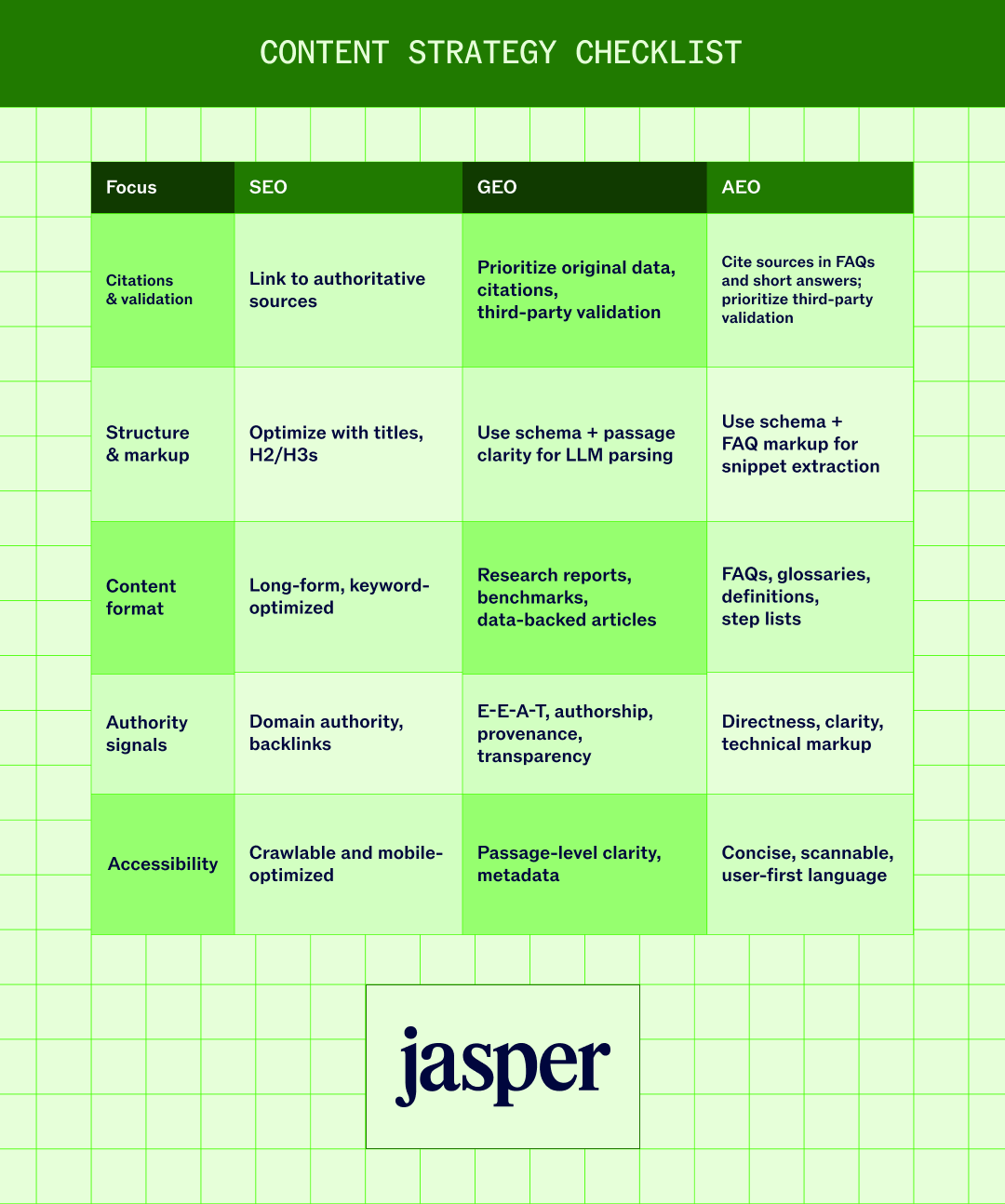
- Blog posts and articles: Creating in-depth, data-driven articles, research reports, and benchmark studies helps build authority for GEO. For AEO, structuring blog posts with FAQs, "how-to" sections, and clear definitions is key.
- User-generated content: Content on platforms like Reddit and Quora is highly visible in AI search. Engaging on these platforms is crucial.
- Discoverable social content: Videos on YouTube are a primary source for AI answers.
- Product & homepage content: Optimizing these pages to clearly state what your product does and who it’s for helps AI engines understand your brand in response to specific queries. Consistency across these pages is also important so that information about your brand surfaces accurately in LLMs.
3. How often should content be updated to stay relevant for AEO and GEO?
Updating your content is a core part of AEO and GEO strategy. Here’s a suggestion of how often to refresh content and why each cadence matters:
- Every 3-6 months: Review your top-performing pages. Check facts, refresh data/statistics, update dates, and check if citations or sources are still credible. AI models favor freshness and accurate evidence. Outdated data can cost you credibility or citation share. Based on one analysis, content with credible citations and clear statistics boosts visibility by roughly 30-40% over baseline.
- When new developments occur: Push updates immediately if your industry sees a big change (regulation, tech, new research, etc.). Add sources, schema markup, or modify the content structure. Because GEO rewards being a trusted authority with fresh, sourced content, being slow to catch up means competitors may win citations and AI-visibility share.
- Annually: Audit your content library. Prune what's no longer relevant, merge overlapping content, re-structure long-form pieces for better scanability, and ensure schema/structured data is up-to-date. Evergreen content still needs maintenance so it continues meeting AI’s expectations around breadth, authority, and clear structure.
4. What are the top writing tips to optimize content for AI engines and agents?
- Lead with the answer: Start sections with a direct, one-sentence answer to the user's question. Then, expand with supporting details. This makes the information easily extractable for AEO.
- Write conversationally: Use natural language that reflects how people actually ask questions, rather than focusing on awkward keyword phrases.
- Use intent-based headings: Structure your content with H2 and H3 headings that are phrased as common user questions.
- Ensure passage clarity: Make sure key passages are directly quotable and make sense even out of context. For example, explicitly name the subject (e.g., "Brand X offers...") instead of using pronouns like "it" or "the product" where possible.
- Structure for scanability: Break up long paragraphs. Use bullet points, numbered lists, and tables to make your content easy for both humans and machines to read.
5. How can businesses increase their presence on platforms like Reddit and Quora for AEO and GEO?
Since Reddit and Quora are two of the most-cited sources in AI search, building a presence there is a high-leverage activity.
- Engage authentically: Actively participate in relevant subreddits and discussions. Answer questions, offer helpful advice, and establish your brand as a credible voice in the community.
- Claim your brand: Secure your business username and consider creating your own branded subreddit if you have a large enough following to sustain an active community.
- Leverage advocates: Encourage employees, brand ambassadors, and loyal customers to share their positive experiences and expertise. Employee advocacy programs can be a structured way to generate authentic content.
- Monitor mentions: Use tools to find out where your brand and products are already being discussed. Jump into those conversations to provide value and correct misinformation.
6. How can you measure GEO and AEO performance (e.g., citations, visibility, share of voice)?
Traditional metrics like clicks and traffic are becoming less reliable indicators of success in an AI-driven search world. Instead, focus on these new metrics:
- AI visibility: Track how often your brand appears in AI-generated answers for the prompts and topics that matter to your business.
- Share of voice: Measure your visibility against your competitors within AI search results. Is your brand mentioned more or less frequently?
- Citations: Count how many times your content (both on your own site and on third-party sites) is cited as a source in AI responses. This includes both linked and unlinked mentions.
- Sentiment: Analyze whether your brand is being portrayed positively, negatively, or neutrally in AI-generated answers.
Industry-specific considerations
1. How do AEO and GEO strategies differ for B2B vs. B2C companies?
While the overall playbook for AEO and GEO is similar—focus on intent, clear Q&A-style content, and trust signals—the details shift based on whether you’re in B2B or B2C.
- B2B: Queries tend to be more technical or problem-solving (such as “how to integrate with X system”), and brands succeed with longer, in-depth hub pages packed with helpful FAQs and How-To sections. These “chunked” content blocks are what large language models pull into generative answers, according to Profound.
- B2C: Thrives with concise, schema-rich passages (think 100–300 words, well-tagged with Product or Review schema) that link directly to items for sale. B2C GEO also leans on social proof (user reviews, influencer content), while B2B marketers benefit from authority markers like certifications or analyst mentions.
2. Is the conversion rate for AI-driven search queries greater for B2C or B2B businesses?
B2C enjoys quantity, but B2B often gets higher quality. AI-driven searches deliver different kinds of value to B2C and B2B companies:
- B2C: You may see more shoppers landing on your site thanks to AI answers, and moderate bumps in on-site conversions. One study found that B2C e-commerce sites generally maintained or improved performance as an impact of AI Overviews.
- B2B: While the overall volume of traffic is lower, the visitors who do click through from AI-generated results tend to convert at much higher rates.
3. What are the biggest opportunities for e-commerce sites in AI-powered answers compared to traditional SEO?
E-commerce is right at the heart of the generative search revolution, with a few big growth areas:
- Single-answer slots: AI engines like Google's AI Overviews or ChatGPT will often cite just a handful of URLs, so landing any one of those spots has outsized impact, especially as classic blue-link search volume declines.
- Stronger purchase intent: Conversational search tends to guide users quickly from question to product, and retailers report 18–25% higher conversions after introducing generative chat or search, according to Lucidworks.
- Faster content and keyword wins: Gaining visibility in AI-driven product or question pages can be easier and faster than chasing classic SERP traffic.
Future of AI search
1. Are AEO and GEO expected to become "pay-to-play" like traditional Google Ads?
Right now, AEO and GEO don’t seem to be universally “pay-to-play” in the way Google Ads are, but there is a risk that visibility gets biased toward those who invest more. According to recent studies, organic signals like quality content, structured data, topical authority, and brand mentions still play a big role in whether a brand gets cited in AI-generated overviews and responses.
For B2B marketers, that means there’s room to compete if you lean into those organic foundations. Investing in tools and tactics such as digital PR, content production, and monitoring your AI visibility can amplify your gains and help you keep up with competitors who are making those investments.
2. Does SEO have a future in an AI-driven search landscape?
Yes, absolutely. SEO is not dying; it's evolving. The foundational principles of traditional SEO—creating high-quality, relevant, and accessible content—are more important than ever because they form the bedrock of AEO and GEO. AI engines still rely on signals of authority, clarity, and trustworthiness that SEO has always prioritized.
Think of AEO and GEO as new, essential layers on top of your existing SEO efforts. A strong SEO program is the starting point for success in AI search.
For more steps to progress your AI search strategies, download our guide: How to Optimize Content for GEO and AEO in an AI-Native World.

More of the latest & greatest

Introducing Multiple Audiences: Write for the Whole Buying Committee
Craft content that resonates with multiple target audiences simultaneously with Jasper Multiple Audiences. Attach up to four audiences to one AI generation, so a single asset reaches the whole buying committee.
October 15, 2026
|
Mason Johnson

How to Audit and Analyze AI Crawler Traffic on Your Website
AI crawlers are changing how content gets discovered and surfaced in AI search. Understanding their behavior gives marketers greater visibility into how AI engines interact with their websites.
October 14, 2026
|
Kurt Lambert

Enterprise GEO Platforms: Evaluation Criteria for Marketing Teams
The right enterprise GEO platform connects AI search visibility insights to content optimization, with the measurement and governance capabilities needed to scale.
October 14, 2026
|
Mason Johnson